The Price of Exit Intent: SIP-4 and the Birth of Onchain Rights
The history of onchain finance is often not written in whitepapers. It is written in Event Logs.
Uniswap’s Swap, Mint, and Burn turned exchange and liquidity into public events. Countless protocols later copied this language, and DeFi Summer grew out of those logs.
But perpetual futures have always had a strange blind spot. Opening a position has been fully productized. Exiting has mostly stayed in the button era.
TP is a button. SL is a button. Once triggered, the position ends, and the story ends. Whether it was a real trend or just one murderous wick, the system does not care.
SIP-4 wants to rewrite this.
Exiting should not merely be the end.
Exit intent can become an asset.
Why SIP-4 Exists
Product competition among Perp DEXs often ends up in the same place: faster matching, lower fees, more pairs, more incentives.
All of these matter. But StandX has been asking a different question. Instead of only chasing what already works, can we create a new way to trade?
From SIP-1 to SIP-3, every step StandX has taken has tried to answer one question: can margin, positions, and trading intent become more efficient than they are on traditional Perp DEXs?
SIP-4 is another heavy answer.
Traditional TP and SL feel like a cold will.
You write down a price in advance. Once the market touches it, the system sends you away. Whether that was a real reversal or a liquidation needle does not matter. Trading systems do not have empathy. They only have if/else.
But real trading is messier. Sometimes you are willing to take profit yet not in a hurry to sell. Sometimes you want protection without letting one wick kick you out. Often you are not trying to exit at all, you just want to keep the right to choose.
SIP-4 takes that right and brings it into Block Trade. It can be bought by someone else, or used by yourself to protect a position.
That is Block Options.
From Swap to StandXNewOrder: Onchain Trading Gets a New Verb
The first language of onchain trading was exchange, market making, and liquidity.
You have probably seen countless Uniswap Swap, Mint, and Burn Events. They look simple, but they changed the meaning of trading. A trade was no longer just a row inside an exchange database. It became a public event that anyone could read, verify, and build on top of.
This time, what appears on BSCScan is StandXNewOrder.
Not another swap. Not another meme transfer. Not another piece of chart noise that lives for an hour and dies like a disposable lighter.
It records a different kind of trade: the exit right attached to a perpetual position being created, matched, priced, and confirmed onchain.
In a sense, Uniswap wrote swaps into public events. StandX is writing exit intent into public events.
This is not a slide deck option. This is not “trust me bro.”
This is onchain options on perps.
More precisely, it turns TP and SL from a private front end state into an onchain right that can be matched, held, executed, and audited.
Yes, it is still early. The volume is not huge yet. But many new trading forms do not arrive as fireworks. At first, they are just quiet logs.
In that sense, this Event is the birth certificate of Block Options.
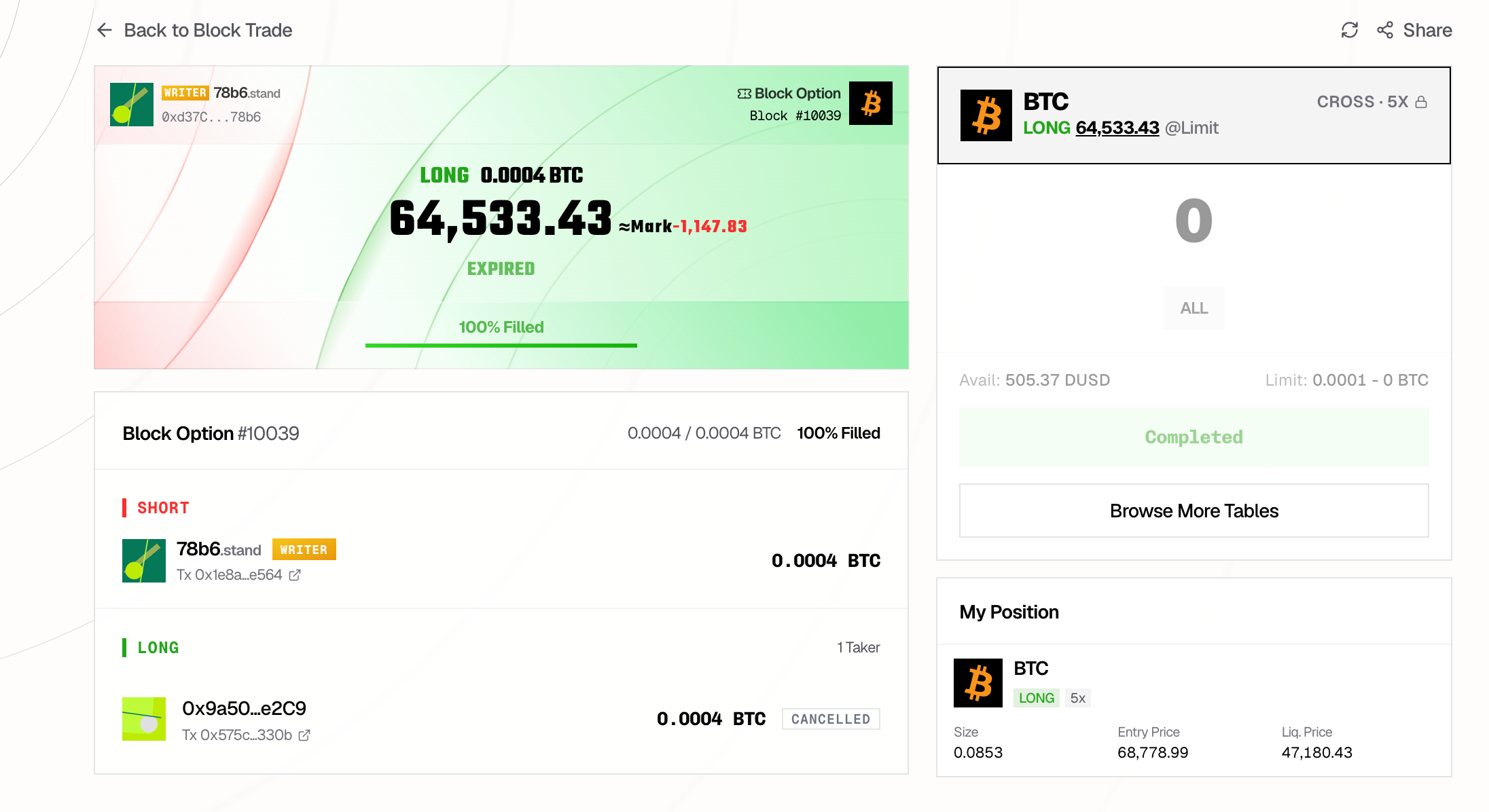
Look at this example.
Someone paid only 0.08 DUSD and received the right to go long 0.0004 BTC at 64,533.43.
BTC was around 65.7k that day. If this right were still valid, would that not feel like picking up a half scratched lottery ticket from the floor?
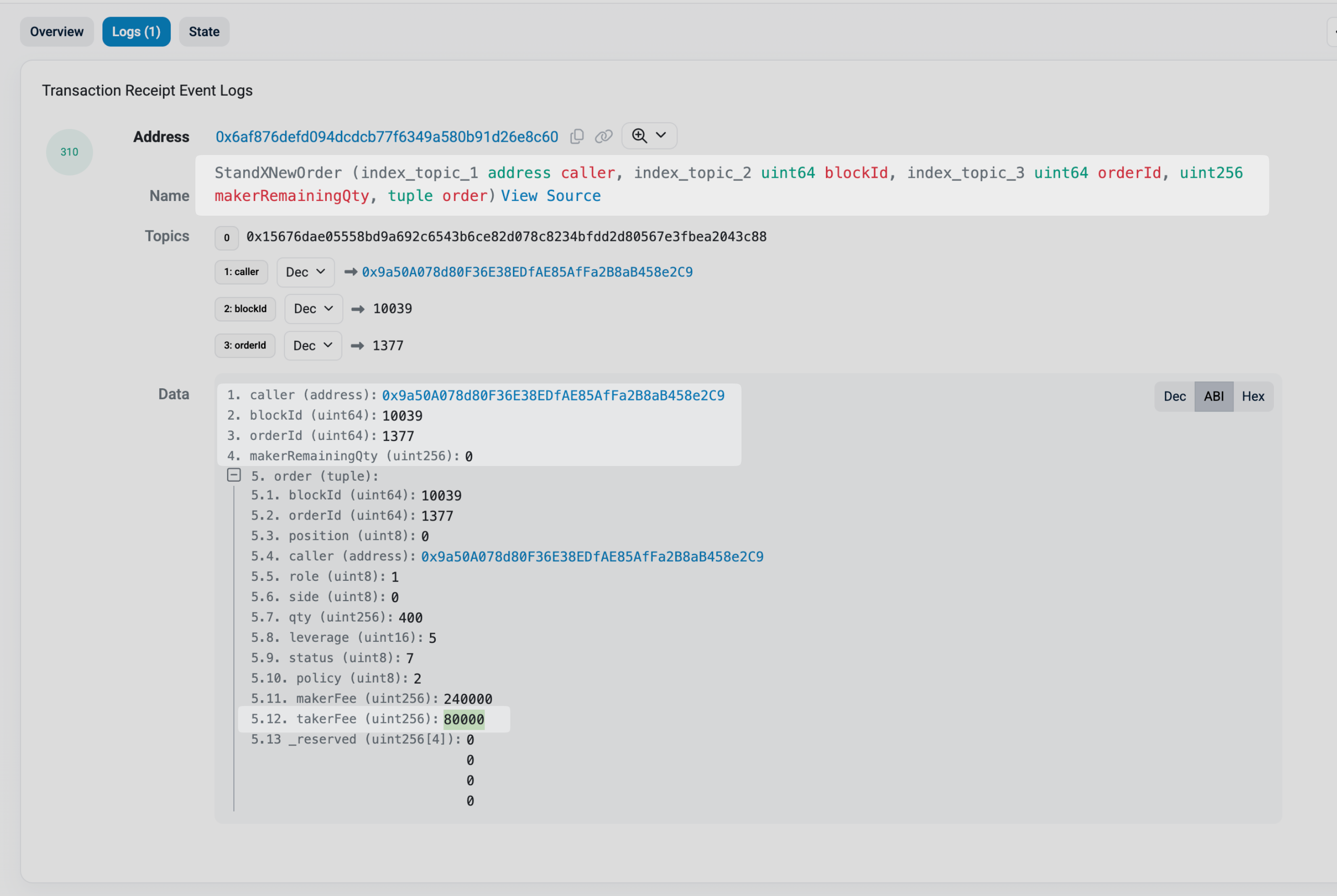
The matching event is also visible onchain.
makerRemainingQty is 0, which means the order was fully matched. blockId, orderId, caller, fee, and qty can all be verified.
On StandX, trading intent is not screenshot literature. It is an onchain record.
My Current Position
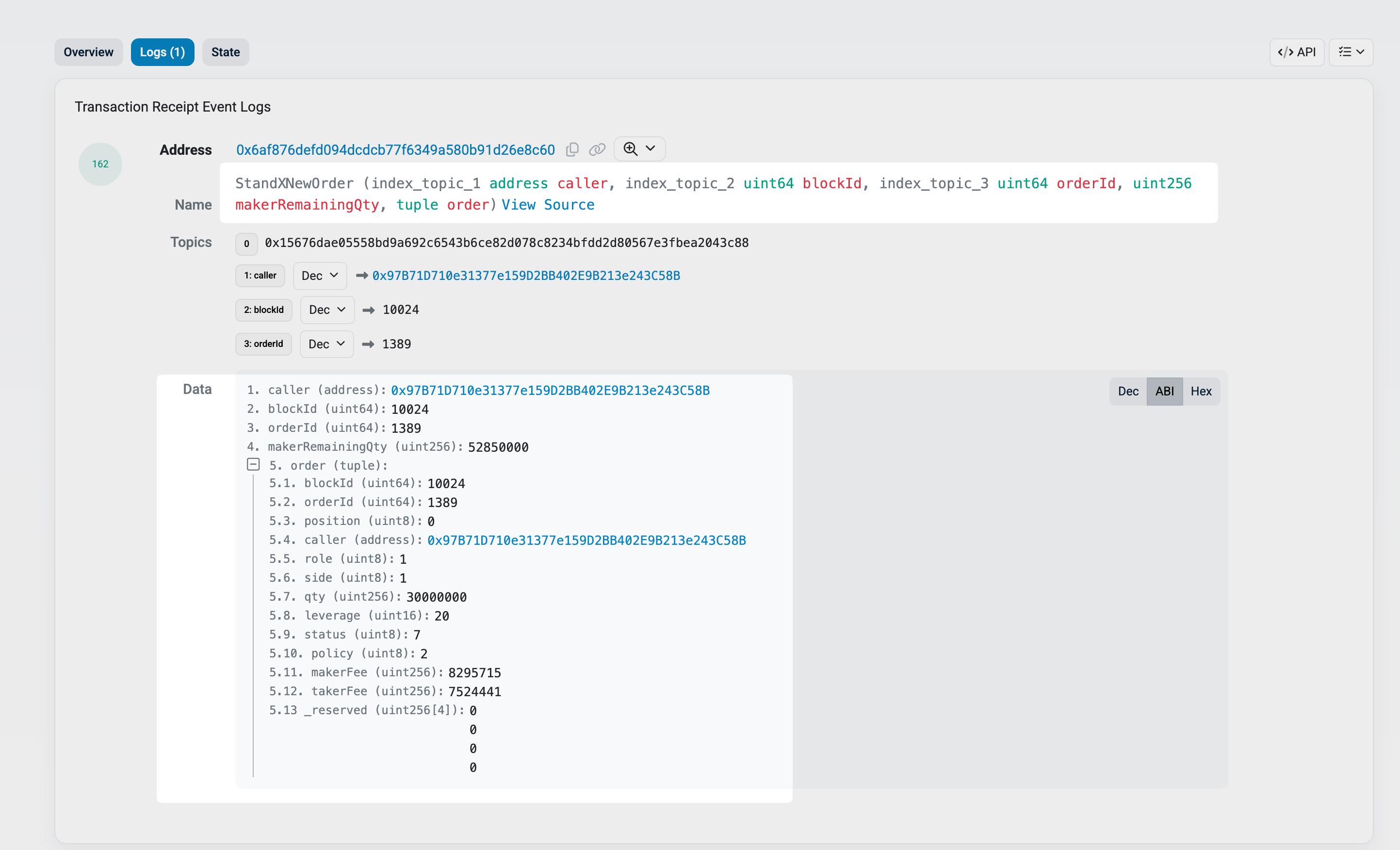
I currently have a BTC USD long position. Size is 0.0853 BTC. Entry price is 68,778.99. Leverage is 5x Cross. Position Yield received is around 26.92 DUSD.
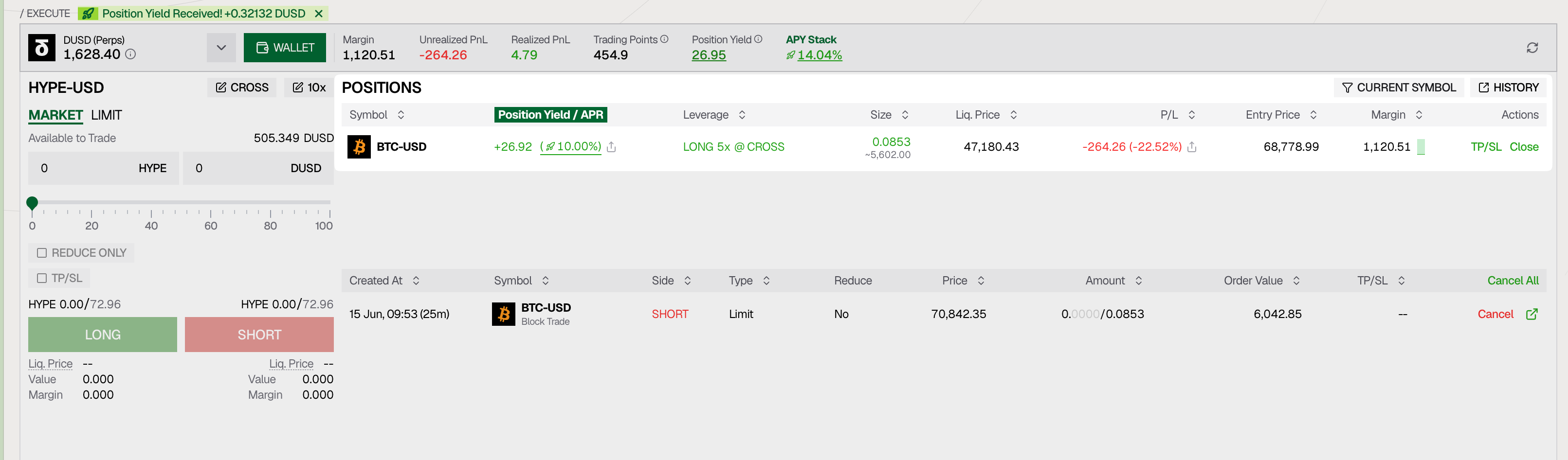
The PnL is not exactly elegant, but the position is alive, and it is still collecting Position Yield.
It is like an employee who slacks off at work but still gets paid every month. The boss goes silent. Finance starts crying.
This is also where SIP-4 feels most real. It does not ask you to open a new position just to try a new feature. It gives an existing position an extra layer of rights that can be managed, sold, or used for protection.
Making Money with SIP-4: I Am Already Willing to Take Profit at 70k
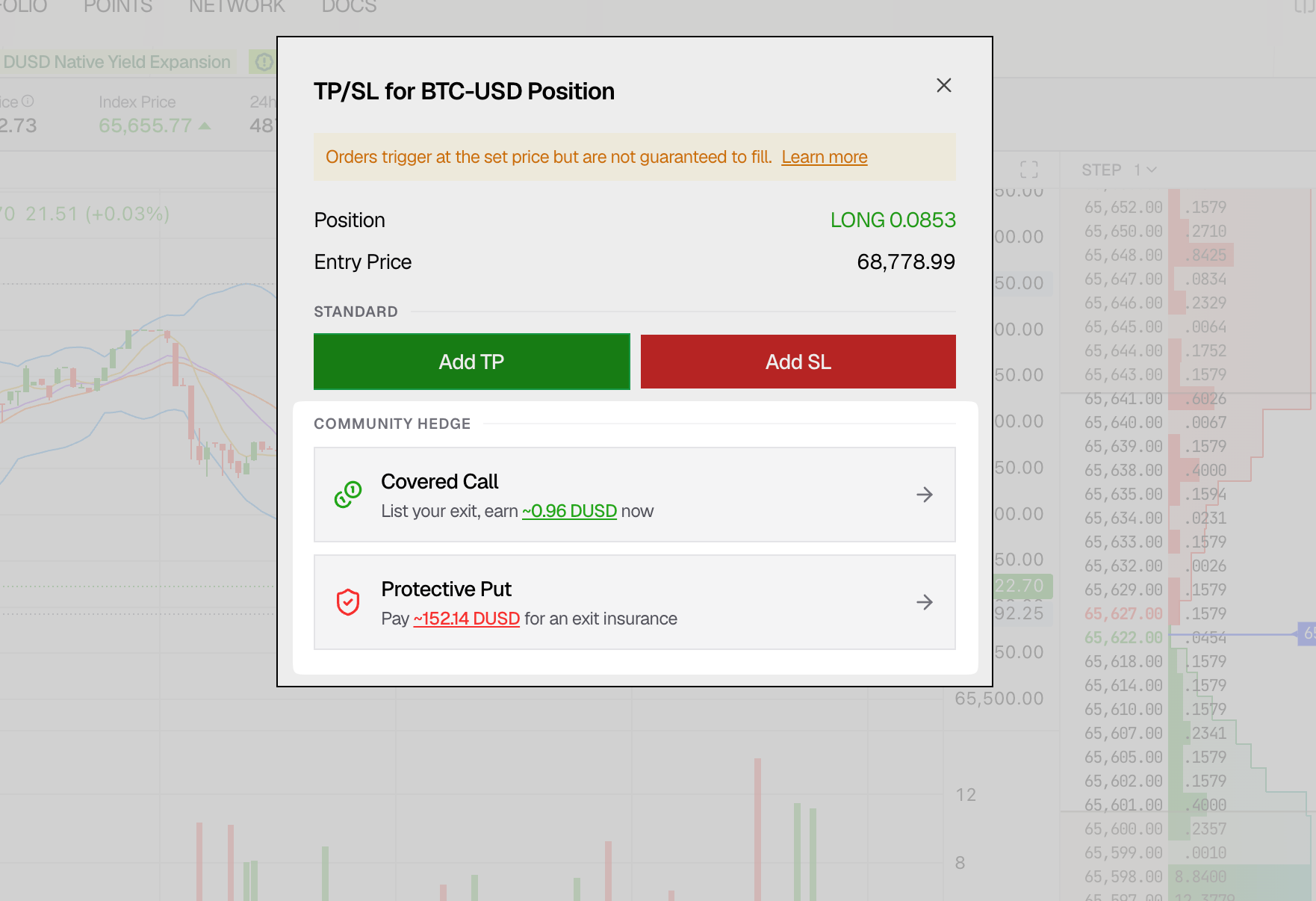
Suppose I am already willing to take profit around 70,842.
The traditional TP method is simple: place a take-profit order, then wait for fate to judge you.
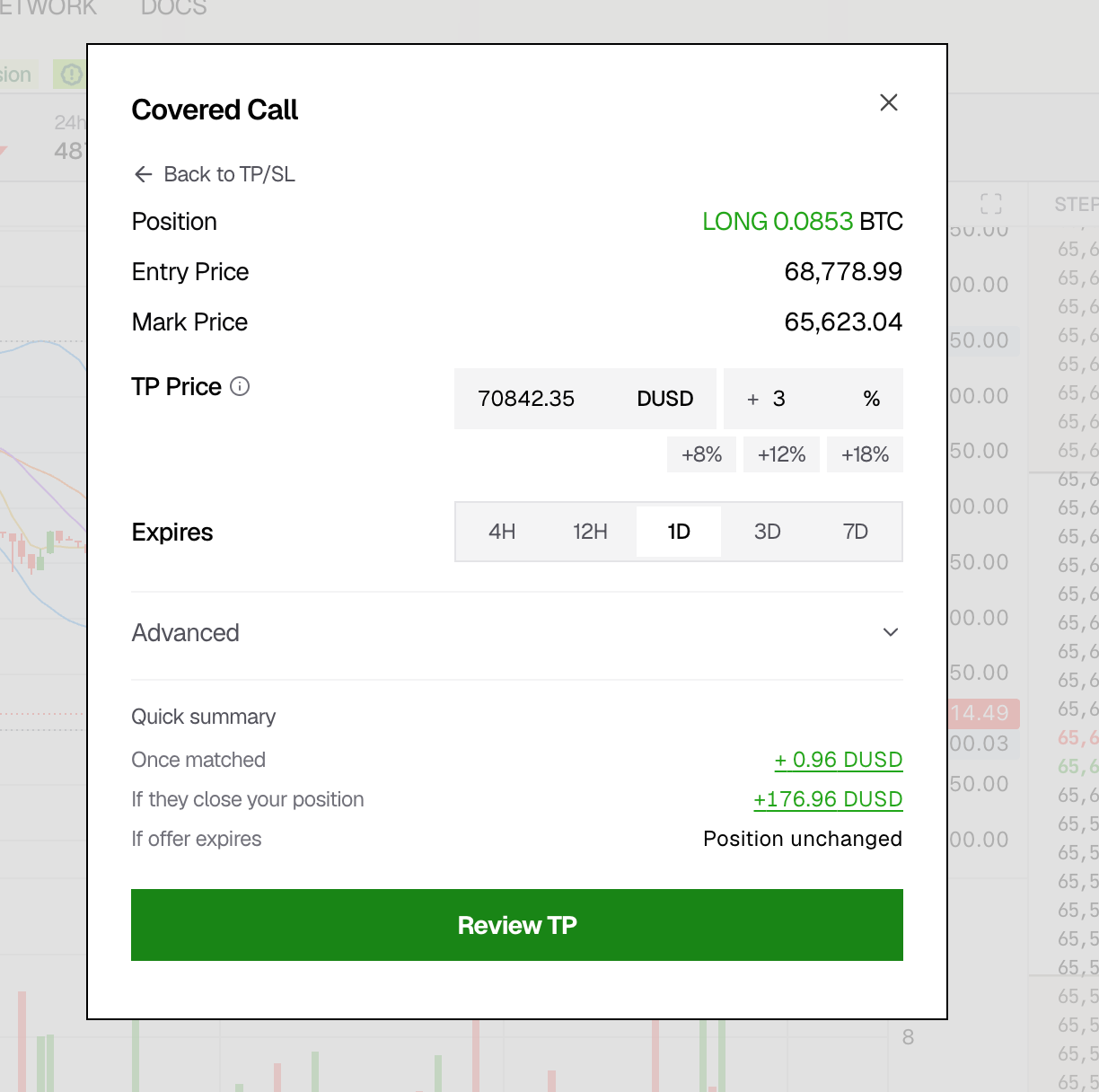
With SIP-4, I can turn this take profit intent into a Covered Call. In plain English, I sell someone else the right to take over this exit opportunity at that price in the future.
Why would anyone buy it?
Because the buyer may believe BTC will keep going up. If BTC later breaks above 70k, having the right to take over around 70,842 is like paying a small fee to lock in a potentially cheaper future entry.
For me, it is also simple.
If the buyer executes, I was planning to take profit anyway, and now I earn an extra fee.
If the buyer does not execute, my position stays, and the fee stays with me.
In the screenshot, I set TP at 70,842.35 and can immediately receive around 0.96 DUSD. If executed, I exit according to plan with around 176.96 DUSD in profit.
A normal TP is standing by the road waiting for a car.
Block TP is renting out the waiting spot while you wait.
Even capitalism would pass me a cigarette.
Protecting Positions with SIP-4: You Are Not Stopped Out. You Choose to Stop.
The problem with stop loss is not that it is useless. The problem is that it is too loyal.
You write down a price, and it really executes. Even if it was just the market playing a prank.
The market wicks down once, and it executes.
The price immediately comes back, and it does not apologize.
After you get kicked out, all you can do is stare at the rebounding candle like a modern human betrayed by the button he created himself.
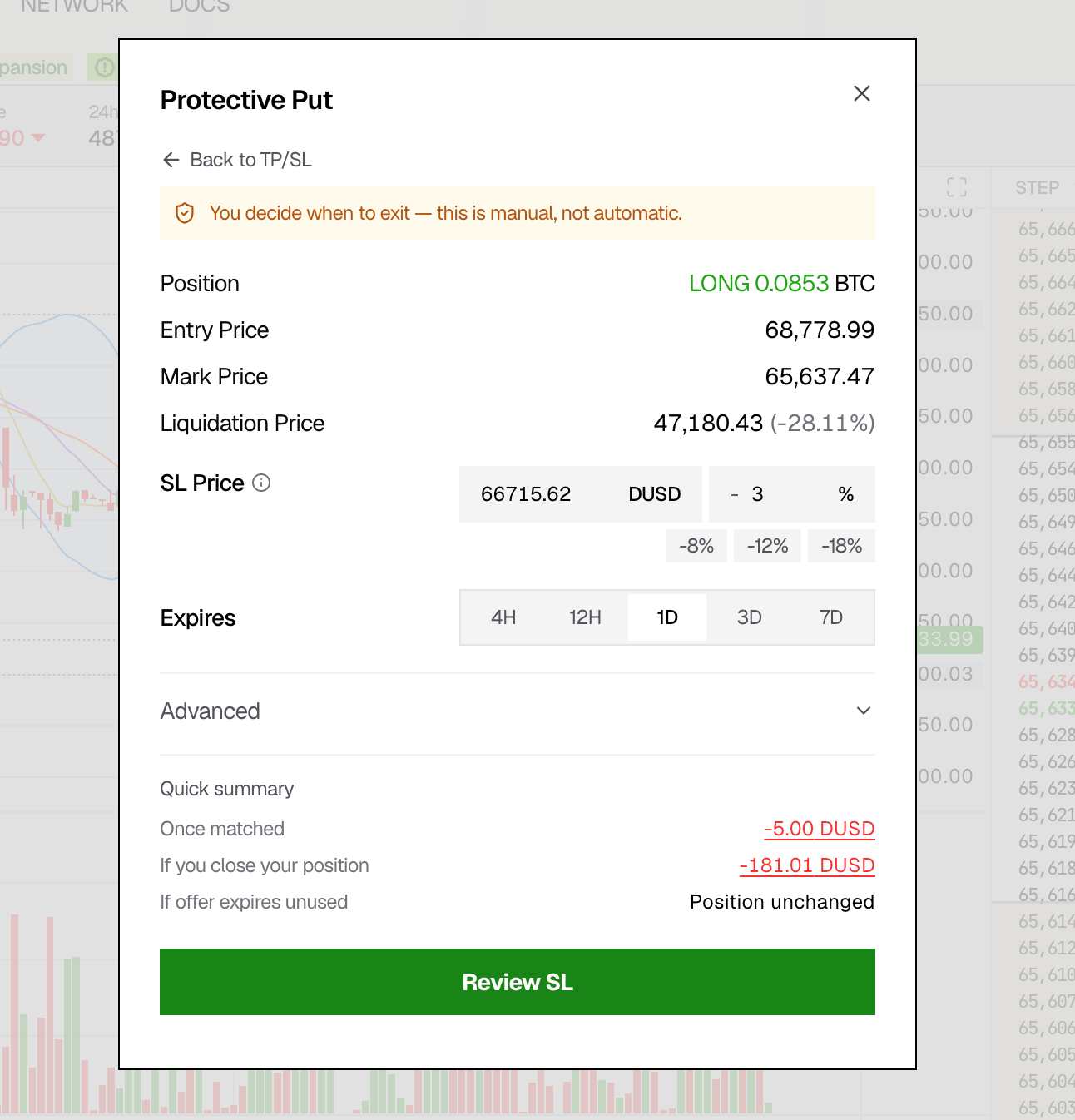
SIP-4’s Protective Put is closer to position insurance.
You pay a fee and receive the right to exit at a specified price within a validity period. But it does not trigger automatically. You decide when to use it.
If the price only wicks and comes back, you do not click.
If the market truly starts rotting, then you Execute.
You are not stopped out.
You choose to stop.
Here is a more direct example.
BTC wicks to 65k, then dumps back to 61k.
The old stop loss exits at 64,718, losing 28. Congratulations, you bought on the needle and sold through the eye of it. The exchange will not even send you funeral compensation.
With an SL Option, you click nothing. The short position remains, and continues making 26.
The same wick: losing 28 versus making 26.
The price of that difference is only 1.65 DUSD.
What if it really does not come back? The button is still there. Within 12 hours, you can exit at 64,718 whenever you choose, and the maximum loss has already been printed on the ticket before you place the order.
That is the meaning of optionality.
Why SIP-4 Is Different
When people think about options, they often think about option chains, IV, Delta, Gamma, Theta.
Then an ordinary trader looks at the page for two seconds, closes it, and goes back to opening 20x perps like a brave hamster who never read the manual.
SIP-4 does not want to do that.
We are not starting from complex financial structures. We start from behavior users already understand: taking profit, stopping loss, protecting a position, locking in a price ahead of time, and either paying for your own optionality or selling it to someone else. These needs happen every day. They simply have not been productized well enough before.
The point of SIP-4 is that it upgrades TP and SL from mechanical triggers into intent trading. Your margin already earns yield inside DUSD, your position collects Position Yield, and your large trades route through Block Trade. Now your exit intent can be priced through Block Options too. The whole system finally feels like a trading network, not just a row of buttons shouting long and short.
This is what StandX truly wants to build on the product side.
Instead of chasing other people’s trends, we want to create our own path. Because if onchain derivatives end up merely copying the old pages of centralized exchanges, then after all this work, we will have simply built a more expensive internet cafe onchain.
Final Thoughts
Block Trade and Block Options are not products everyone gets at first glance. They are not as simple as listing a few more pairs, and not as loud as another points campaign. But they match real trading needs: large trades need better matching, position exits need more flexible optionality, and TP/SL should not always be a blunt automatic switch.
More importantly, onchain derivatives should not just copy the old pages of centralized exchanges. We should be building new trading structures, new ways to organize liquidity, and new ways to express risk.
Most people wait until a trend is already hot before they believe in it. But consensus is never a free lunch. By the time everyone sees it, the price has usually already printed the bill.
SIP-4 is still early, early enough that it looks strange, more like a quiet Event Log than a hot narrative. New trading forms often begin exactly like this. I believe more people will eventually walk the path StandX is walking today, and the ones who stand there early will earn their own yield.
Do not be a follower.
Be a Stander.