
StandX vs Hyperliquid: Perp UX in Practice (User POV)
At a glance, StandX and Hyperliquid can look similar: both are Perp DEXs offering fast execution, leverage, and non-custodial trading. In practice, however, they encourage very different trader behaviors. This article does not aim to declare a winner.
It is based on direct usage of both platforms and focuses on how design choices, capital flow, and on-screen information shape real trading decisions.
All observations are drawn strictly from what is visible on the interface and from practical use.
Overview
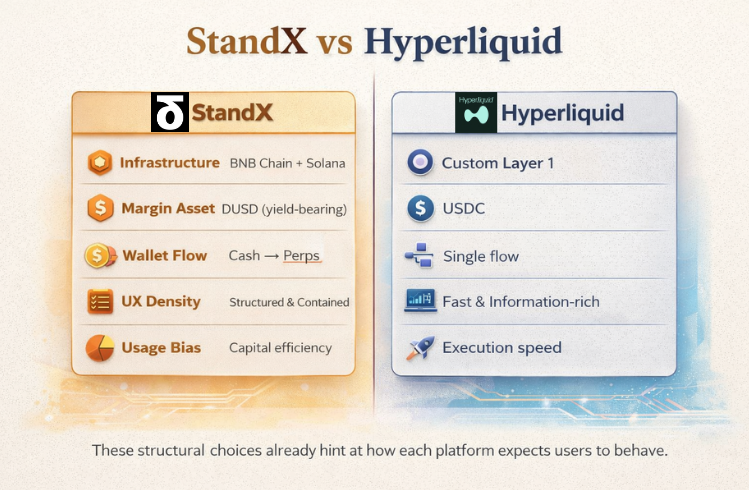
Observations
1. Wallet Flow and Capital Allocation
On Hyperliquid, the capital flow is direct: users deposit USDC and can trade immediately, without intermediate layers.
On StandX, funds first enter the Cash Wallet and must be manually transferred to the Perps Wallet, creating an explicit separation between total capital and capital at risk.
Impact:
-
Hyperliquid minimizes friction and encourages frequent reallocation.

-
StandX forces conscious allocation decisions and reduces impulsive exposure.

2. Risk Visibility and Cognitive Load
On Hyperliquid, risk metrics and account health indicators are visually prominent.
On StandX, risk exists but does not dominate the interface.
Impact:
-
Hyperliquid encourages constant monitoring and frequent adjustments.

-
StandX reduces visual stimuli and favors focus on the trade thesis.

Here, the difference is not technical. It is psychological.
3. Risk Management Tools (TP/SL and Adjustments)
Hyperliquid prioritizes rapid intervention: TP/SL and position adjustments are easy to access while price moves.
On StandX, these tools exist but are less centered in the flow, discouraging continuous micro-adjustments.
Impact:
-
Hyperliquid favors active, reactive position management.

-
StandX favors predefined setups and fewer mid-trade interventions.

4. Market Overview Tools (Top Bar and Metrics)
On Hyperliquid, volume, open interest, and funding appear as a clear snapshot above the chart.
On StandX, market context is more functional and less visually emphasized.
Impact:
- Hyperliquid invites constant market scanning.
- StandX assumes the trader enters with a predefined thesis.
Conclusion
StandX and Hyperliquid do not compete on the same axis. They represent two distinct philosophies of how a trading environment should behave. Hyperliquid prioritizes speed, information density, and constant presence. StandX prioritizes structure, capital efficiency, and operational clarity. The most useful question is not which is better, but which one aligns more closely with your trading behavior.
Disclaimers:
- This comparison is based on direct interface usage and observation.
- No advanced statistical performance tests were conducted.
- The goal is to show how design choices influence human decision-making, not to predict financial outcomes.