StandX SIP-5: Universal Markets Listing
Every crypto cycle had its open-issuance moment.
Memecoin launchpads cracked ultra-early assets. Uniswap unlocked spot trading. Derivatives, the largest and deepest market surface in crypto finance, never had their turn.
Until SIP-5 just shipped.
Universal Markets Listing hero
This isn’t another feature drop. It’s worth understanding properly, not as a recycled “Uniswap moment” cliché, but for what it actually changes structurally.
The problem.
Every perpetual listing on every major DEX still requires permission from the protocol team. @HyperliquidX, @Lighter_xyz, @edgeX_exchange, @Aster_DEX: all curate which assets you can trade. Tens of trillions in annual crypto derivatives volume, structurally bottlenecked at the listing layer.
The diagnosis isn’t controversial. What’s been missing is a credible mechanism that returns listing rights to the market without breaking risk control.
What SIP-5 actually does.
Anyone meeting the staking thresholds can become a Sponsor and deploy a perpetual market for any asset, narrative, on-chain event, or pre-TGE token. No StandX approval required.
The mechanic in 30 seconds:
- Sponsor stakes DUSD (or future $X) and proposes a market.
- 100% of that stake funds a Reward Vault that pays community market makers, measured tick-by-tick on uptime, depth, and quote quality.
- As volume builds, fees flow back into the system.
- The Sponsor earns a configurable cut, but only while the market stays healthy.
- The Sponsor can enable Stand Mode, which automatically recycles their fee share into the MM rewards pool, turning the market into a self-feeding flywheel.

Self-growth loop diagram
The protocol takes zero listing fees from the budget. Community capital, hiring community market makers, building community markets.
The vertical integration that makes this possible.
SIP-5 isn’t a feature you can copy by reading a spec. It requires three production-grade infrastructure layers working in sync, and StandX has been quietly shipping each one since November 2025.
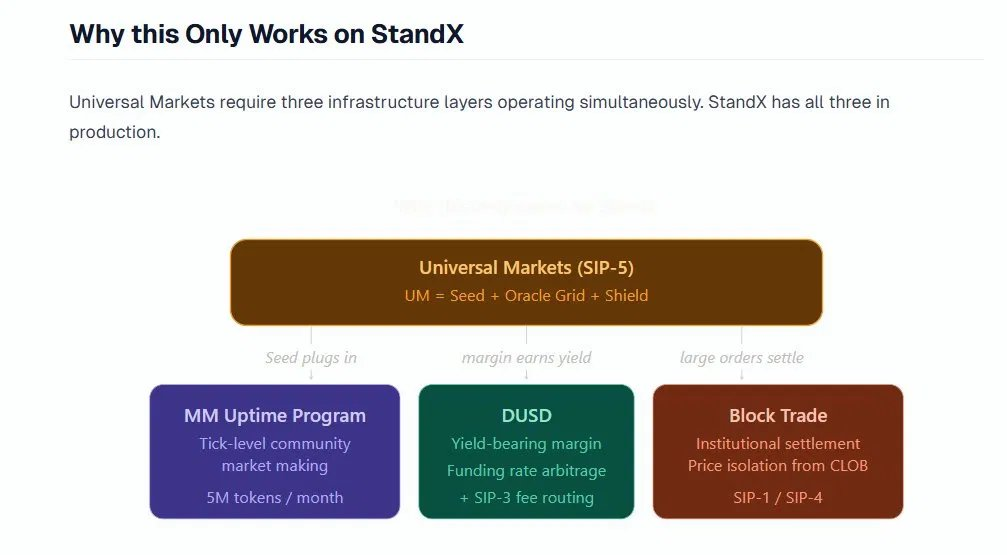
Why this Only Works on StandX
This is the part most “Uniswap for perps” copycats won’t be able to replicate. You need:
- A yield-bearing base asset (DUSD) as universal margin.
- A tick-level community market making program already running (MM Uptime).
- A block trade engine for institutional flow isolation (SIP-1 / SIP-4).
The “awkward timing” of the mainnet launch and the months of “just farming” make sense in retrospect. Every step was infrastructure for this moment.
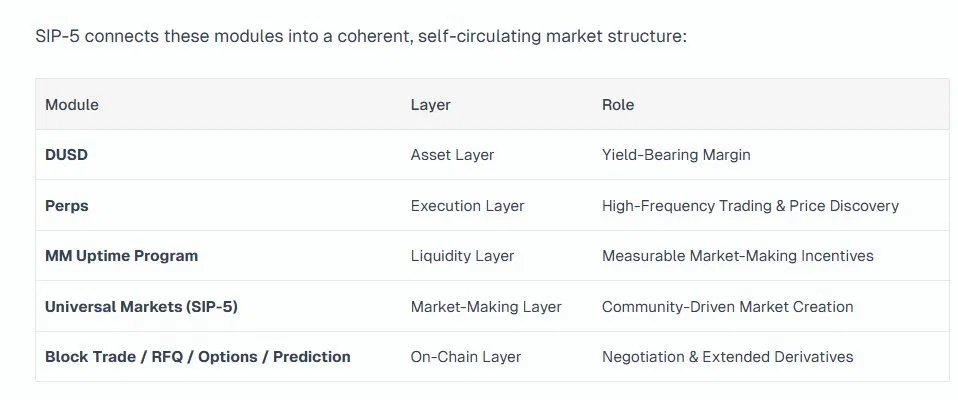
SIP-5 module integration table
The architectural detail most launchpads get wrong.
SIP-5 strictly separates two vaults that most derivatives platforms conflate:
- Market Shield: the Sponsor’s first-loss capital that absorbs liquidations
- Reward Vault: incentives for community MMs and traders
They never bleed into each other. From the SIP spec:
“Already-earned MM rewards can never be retroactively clawed back to plug a Market Shield hole.”
This is the kind of detail that separates well-architected systems from launchpads that look clean until something explodes. A failing market doesn’t punish the people who provided its liquidity.
Why ‘Stand Mode’ is cleverer than it looks.
Stand Mode cycle
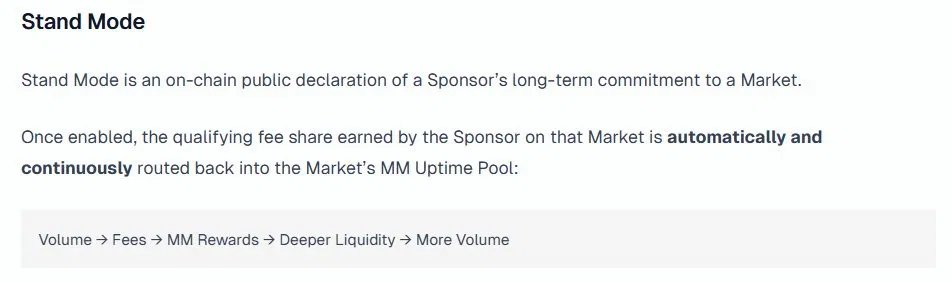
When a Sponsor enables Stand Mode, they’re publicly declaring on-chain: “I’m giving up my short-term fee income to deepen this market long-term.”
Every toggle is permanently recorded. Reputation becomes code. Short-term extractors get algorithmically filtered from long-term market builders. No social signaling needed, just on-chain commitment receipts that anyone can verify.
The Sponsor and community MM relationship.
Market Maker quote section
Direct from the spec:
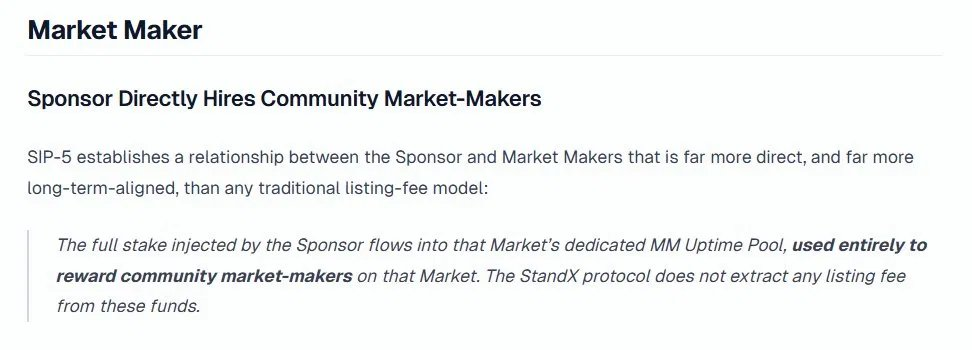
“The full stake injected by the Sponsor flows into that Market’s dedicated MM Uptime Pool, used entirely to reward community market-makers on that Market. The StandX protocol does not extract any listing fee from these funds.”
This is the structural break with the traditional listing-fee model. There’s no zero-sum game between protocol and Sponsor. The Sponsor isn’t paying to list. They’re directly hiring community MMs to grow a market they’ll long-term benefit from.
The detail nobody is talking about: the Seeding Pool.
3-5% of total platform fees route into a protocol-level pool that bootstraps liquidity for promising new markets when their initial budget runs low. Mature markets nourish seedling markets.
It’s a built-in immune system against cold-start death, the failure mode that kills most launchpad-style frameworks.
The economic shift this represents.
Most perp DEXs today are racing to zero on fees. @Lighter_xyz, @edgeX_exchange, @Aster_DEX, @grvt_io, all competing on fee compression. That race kills protocol economics over time.
SIP-5 changes the game: @StandX_Official scales by adding more markets the community wants, not by squeezing margins. Unit economics improve with breadth, not compression. Structurally healthier.
Who’s behind this matters.
Aaron Gong ( @StandX_AG ), former VP of Binance Futures, ex-CME Group where he launched APAC Bitcoin futures.
Justin Cheng, former Director at Binance Futures.
Plus Goldman Sachs alumni on the team.
This isn’t a crypto-native team aspirationally pivoting to derivatives. This is the team that helped build the world’s largest derivatives venue. They know exactly where the gatekeeping happens because they used to be the gatekeepers.
That doesn’t guarantee execution but it means the diagnosis of the problem is informed.
Risks worth keeping in mind.
This isn’t a pump call. Three real tail risks:
Execution complexity. Oracle Grid, Sponsor framework, Stand Mode, Market Shield, ADL inheritance. Significantly more moving parts than Uniswap’s swap function. More surface area, more potential failure modes.
Sponsor adoption risk. The framework only works if quality Sponsors show up in the first 60-90 days. If only low-effort proposals come in, the narrative breaks.
Regulatory exposure. Permissionless derivatives is a clear potential target for CFTC and MiCA. Not a reason not to build it, but a real tail risk that doesn’t exist for permissioned competitors.
The next 60-90 days of execution will tell us if this is the third paradigm or just an ambitious document. How many Sponsors actually deploy markets, how healthy those markets stay, how the Oracle Grid holds up. That’s the data that matters.
Bottom line
SIP-5 is one of the most differentiated proposals in the perp DEX space since Hyperliquid.
It is not just about listing more assets. It is about opening a new layer of market creation for derivatives, where Sponsors, community market makers, and traders can coordinate around permission-less markets with clear incentives and risk control.
The team has real derivatives experience. @StandX_Official previous infrastructure starts to make much more sense with this launch. And the timing comes right when the market needs more than another fee war.
The next few months will show how quickly the model gets adopted, but the direction is clear: if StandX executes well, SIP-5 could become an important step toward a new stage of on-chain derivatives. The timing aligns with where derivatives infrastructure needs to go next.
Full SIP-5: docs.standx.com/blog/articles/sip-5-permissionless-listings-on-anything