Friendly warning: Very long preface ahead ⚠️
StandX has been in development for about a year and a half. In 2025 we started from DUSD, and spent the first half year going live on both Solana and BSC, because we wanted SVM and EVM connected from the start. In June we began building perps, started testing around September, and launched in December. Since then we have been shipping SIPs (StandX Improvement Proposals) back to back, and only recently has the loop started to feel complete.
That route also shaped how people see us: first a stablecoin, then a perps DEX. So the public perception stopped at stablecoin + perps.
Along the way I kept piling up things I wanted to say, a lot of it emotional. But I kept telling myself, wait until perps ships. Then wait until testing is done. Then wait until the SIPs are complete. And here we are.
What exactly are we building? Why start a company in crypto at all? Are we just another copycat? What am I actually doing? When you pour that much of yourself into a product, head down for months, you sometimes get this moment: you suddenly look up, look around, and your eyes go blank.
To answer those questions, I go back to why I came to crypto in the first place.
I believe this is where the flow of money is headed. Human history is a history of exchanging value: barter, then gems and precious metals, then paper money, then electronic payments. Exchange keeps getting faster, and it is not done yet. You notice that plenty of transactions are still stuck at some chokepoint, and that is why crypto exists. To me the value of crypto is trustlessness. Decentralization is the means; trustlessness is the end. It is like the internet in the early 2000s: plenty of bubbles, but the direction was simply right. So even with all the ugly stereotypes this industry carries, I hold my position: the direction is right, the same way the internet was right and the spread of AI is right. This is the tide of history, and it does not turn back.
But the more information flows, the more transparent everything gets, the fewer people actually create. Whatever people set out to do, the first move is to search how others did it and take that as the baseline. After Hyperliquid broke out, the market filled up with dozens of pixel-level imitations: same interface, same listing process, same playbook. When every product is the same, the competition is no longer about product. It is about capital, distribution, and subsidies. And once you take someone else as your baseline, their ceiling becomes your ceiling. Your best possible ending is to become a later version of them.
The best moments of this industry have always come from someone building a thing that did not exist before: Bitcoin, Uniswap, Pumpfun. Not one of them won by imitation.
In 2024 I was doing MEV, scanning pools on chain every day. Protocols like Uniswap had 402,889 pools on ETH Mainnet and over 1,200,000 on BSC. By the first half of this year, Pumpfun had seen 18,670,000+ tokens with trading activity, an asset count in the tens of millions. Uniswap handed the right to open a spot market to everyone. Pumpfun handed the right to issue early assets to everyone. Each time, the result was an explosion of several orders of magnitude. Meanwhile, on the perps side, trading pairs are still stuck around the 500 level.
Open it up, make it permissionless, and the community will produce 1,000,000 pairs on its own. Keep it inside today’s listing process, and even at a diligent 10 new pairs a day, you would need 273 years.
So what is StandX actually after? Starting from perps, 1,000,000 universal markets. StandX has 11 pairs today. When SIP-5 ships, the state I want is to skip the 500 level entirely and redefine what this market looks like at the scale of 1,000,000.
That also answers why StandX started from DUSD. For a million markets, question one: what do you price in? That unit has to grow together with the system. Question two: what makes people show up? Yield. The sponsor’s locked capital, the maker’s resting orders, the trader’s positions, all of it earning, so every new market is born with income built in, no subsidies required. Behind Uniswap stood ETH. Behind Pumpfun stood SOL. DUSD is not our first product. It is the precondition for every other product.
This road is far harder than forking a codebase: listing, oracle, liquidation, market making, risk, delisting, every piece designed from scratch and made to interlock into one system. But it is worth doing precisely because it is hard, and it fell to us precisely because nobody else was doing it. You do not chase the wind. You solve tomorrow’s problem ahead of time, and when the wind arrives, you are already standing at the center of it.
Doing Exactly One Thing: Opening 1,000,000 Universal Markets
If you are looking at StandX for the first time, you will probably conclude: they have DUSD, they have a perps DEX, so StandX equals stablecoin + perps. Understandable, that is what it looks like from outside. But that is like saying a car equals four wheels plus an engine. Every part is correct, and you still have no idea where the car is going.
The PPAP song starts playing in my head:
I have a pen, I have an apple, uh, Apple-Pen.
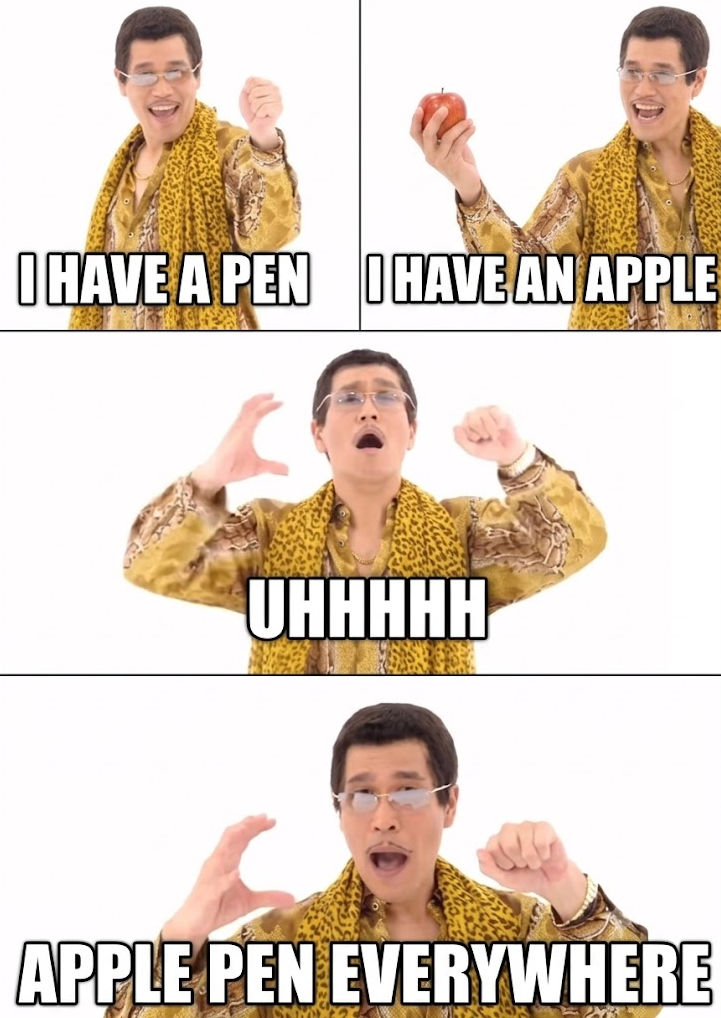
The joke is the mechanical stitching of two things. The apple is still an apple, the pen is still a pen. The name changed, nothing new was created. Describing StandX as stable + perps is telling the same Stable-Perp joke. It sounds right, and it is only the surface.
We are really doing exactly one thing: opening 1,000,000 universal markets.
A universal market comes down to one sentence: opening a market no longer requires a platform’s nod.
And market here means more than perpetuals. The SIP-5 framework covers perps, spot, prediction, and pre-market. Anything that can be priced and traded can be a market. Today, if you want to trade an asset, you first wait for an exchange to want it. Universal markets flip that completely: any asset, any project, any community that meets the public rules can open its own market on StandX. The sponsor brings the asset and the responsibility, makers bring order book liquidity, traders come to trade, DUSD serves as the unified margin, and fees and yield go back to the people actually in the market. Good markets keep growing. Bad markets exit transparently.
DUSD, perps, Block Trade, Position Yield, DUSD Native Yield, Block Options, Community Maker Yield: all of it is paving the road to this one thing.
The Next 10,000x: $61.7T of Volume, 1,000,000 Pools Onchain, 500 Perps Pairs
Perpetuals became the main arena of crypto trading a long time ago.
Reuters, citing CryptoQuant, on the 2025 crypto market:
- Perpetual futures volume: $61.7 trillion
- Spot volume: $18.6 trillion
Perps trade at 3.3x spot. The most active traders moved from spot to derivatives long ago.
But the other set of numbers is more interesting.
In September 2024 I scanned the Uniswap pools on ETH mainnet: 402,889 pools in total, of which roughly 81,000 UniV2 and UniV3 pools had usable liquidity. In the same period, BSC had over 1,200,000 pools with token records.
Pump.fun is wilder. Per CoinGecko, from January 2024 to June 2026, over 18,670,000 tokens saw trading activity on Pump.fun, averaging more than 21,000 new ones per day.
Now look at the perps side: Hyperliquid, the biggest, lists 369 pairs. Aster lists 519.
Put the numbers side by side:
- Uniswap pools on ETH mainnet alone are 1,000+ times Hyperliquid’s entire pair count
- Pump.fun mints in one day 50+ times what Hyperliquid has listed in its lifetime
- And perps volume is 3.3x spot
Sure, those pools and tokens include piles of junk pools, dead pools, and coins that went to zero. That is not the point. The point is an anomaly: the market with 3.3x the volume has three orders of magnitude fewer tradable assets.
There is only one conclusion:
Perps demand exploded long ago, and supply is still locked. Closing the gap from a few hundred pairs to the scale of onchain assets is a 10,000x space. It is the largest unopened gap in crypto.
Why is it like this? Because Uniswap gave everyone the right to open a spot market, Pump.fun gave everyone the right to issue an asset, and the right to open a perpetual market is still locked inside every exchange’s listing committee.
History has already repeated twice: hand the right to open markets back to the market, and the market count does not double, it goes up 10,000x. It happened to spot. It happened to memes. Perps are next.
That is the position StandX is cutting into. Traders want more things to trade. Projects want their own derivatives markets. Communities want to provide liquidity for their own assets. What actually blocks them is that nobody has turned listing, oracle, risk, liquidity, fee routing, market making, liquidation, and delisting into one complete, public framework. StandX is here to build that framework.
Why it Must be DUSD: When the Foundation Earns, Every Floor Above it Earns
The base of trading is pricing, and the base of pricing is the quote token, the unit of account. In BTC/USDT, USDT is the quote token: every price is quoted in it, margin is posted in it, PnL settles in it. In perps, the quote token is not just a balance and not just margin. It decides whether the capital in the whole system is sleeping or working.
And this quote token needs to be designed together with the trading system, not plugged in afterwards. Pricing, margin, PnL, fee routing, Reward Vault, Shield Vault, liquidation: across a million markets, every computation has to land on the same unit or nothing interlocks. Wire in a generic stablecoin and it lives in the system as a mere balance. How yield gets split, where fees flow back, how vaults get scheduled, none of that can be written into the asset itself. Only a quote token that grew up with the system can carry those mechanics built in, one unit running through every computation. The Hyperliquid community later pushed USDH, which was essentially the same realization, but as a patch after the fact. StandX ran the order in reverse from day one: build the asset layer first, then the trading layer. You pour the foundation first. You do not retrofit it.
If margin does not earn, every yield downstream has to be pushed uphill with campaigns, points, and subsidies, surviving one day at a time. Once DUSD earns, the logic of the whole system changes: margin is earning, positions are earning, the order book is earning. Even opening a market, meaning a sponsor launching a new market on StandX and locking DUSD into its Reward Vault and Shield Vault, becomes a self-growing business: before the market has even grown up, the locked DUSD is already earning.
Yield-bearing margin usually gets read as a little treat for users. For a maker it changes the cost structure: the opportunity cost of inventory is the real cost of market making. Quote on another venue and your capital sits dead. Quote on StandX and your capital keeps earning the whole time, so the cost of making markets drops structurally. Lower cost means makers quote deeper and tighter, and the book gets better. That is also why SIP-5A dares to hand market making to the community: DUSD is the variable that makes community market making economically viable.
That foundation is DUSD. When the foundation earns, every floor built on top of it earns. The whole system is a machine that supplies its own blood, no subsidy transfusions.
A system that wants to carry 1,000,000 universal markets needs productive collateral first. Otherwise, the more markets, the heavier the subsidies, the weaker the system.
SIP-3 routes perps fees back to DUSD holders. From then on DUSD is more than a yield-bearing stablecoin: on top of the base interest, the fees generated by StandX’s trading system flow into its yield. Higher yield attracts more DUSD. More DUSD carries more markets and more volume, which produces more fees. Value is not merely transferred onto DUSD. It compounds on DUSD.
So, to be precise, StandX is Stablecoin × Perps, not Stablecoin + Perps. The problem with Apple-Pen is that the apple stays an apple and the pen stays a pen. On StandX, DUSD is changed by perps: fees and funding become its source of yield. And perps are changed by DUSD: yield-bearing margin gives them capital bandwidth nobody else has. A plus sign is assembly. A multiplication sign is reflexivity. Other perp DEXs are renting a storefront inside the dollar system. StandX is building an economy with its own native settlement asset, and DUSD is that economy’s M0: trading, market making, opening markets, carrying risk, all denominated in it, flowing through it, staked in it. You can fork a product. You cannot fork the asset layer.
First Up: 11 Deep Markets
If the goal is 1,000,000 universal markets, why does StandX only have about a dozen pairs right now? The answer is simple and cold: liquidity only flows into liquidity.
A new exchange with no VC, funding everything itself, opening 100 or 300 pairs on day one with no depth in any of them: it looks lively, and it is actually irresponsible to users. A pair without liquidity only gives users worse fills.
So before SIP-5, we concentrate on making a handful of markets genuinely deep. StandX’s BTC order book has held more than 800 BTC of depth within a 10 bps spread. Hold a BTC position here and the margin is yield-bearing DUSD, the position earns, and the maker earns. We want users to develop one instinct: if you are holding a BTC position on chain, you should be on StandX.
A platform listing tokens by itself is addition: 11 this year, 50 next year, 100 the year after. Handing the right to open markets to the market is multiplication: every sponsor brings their own asset, every community brings its own makers and traders, markets breed markets, layer pushing layer. Uniswap did not list its way to 400,000 pools one at a time. Pump.fun did not review its way to 18,670,000 tokens one at a time. They opened the gate, and the market poured in.
1,000,000 markets listed one by one by a platform is not a bad idea. It is an impossible one. At 10 a day it takes nearly 300 years. The only way is to let markets grow on their own. SIP-5 is that gate.
SIP-1 to SIP-5: Paving the Road to a Million Markets
If you only look at the UI, DUSD, and today’s handful of pairs, it is easy to misread StandX as the combo plate from the beginning of this piece: a stablecoin, plus a perp DEX with a dozen pairs, two unrelated products squeezed together.
But walk from SIP-1 to SIP-5 and you will find every step preparing for the same goal.
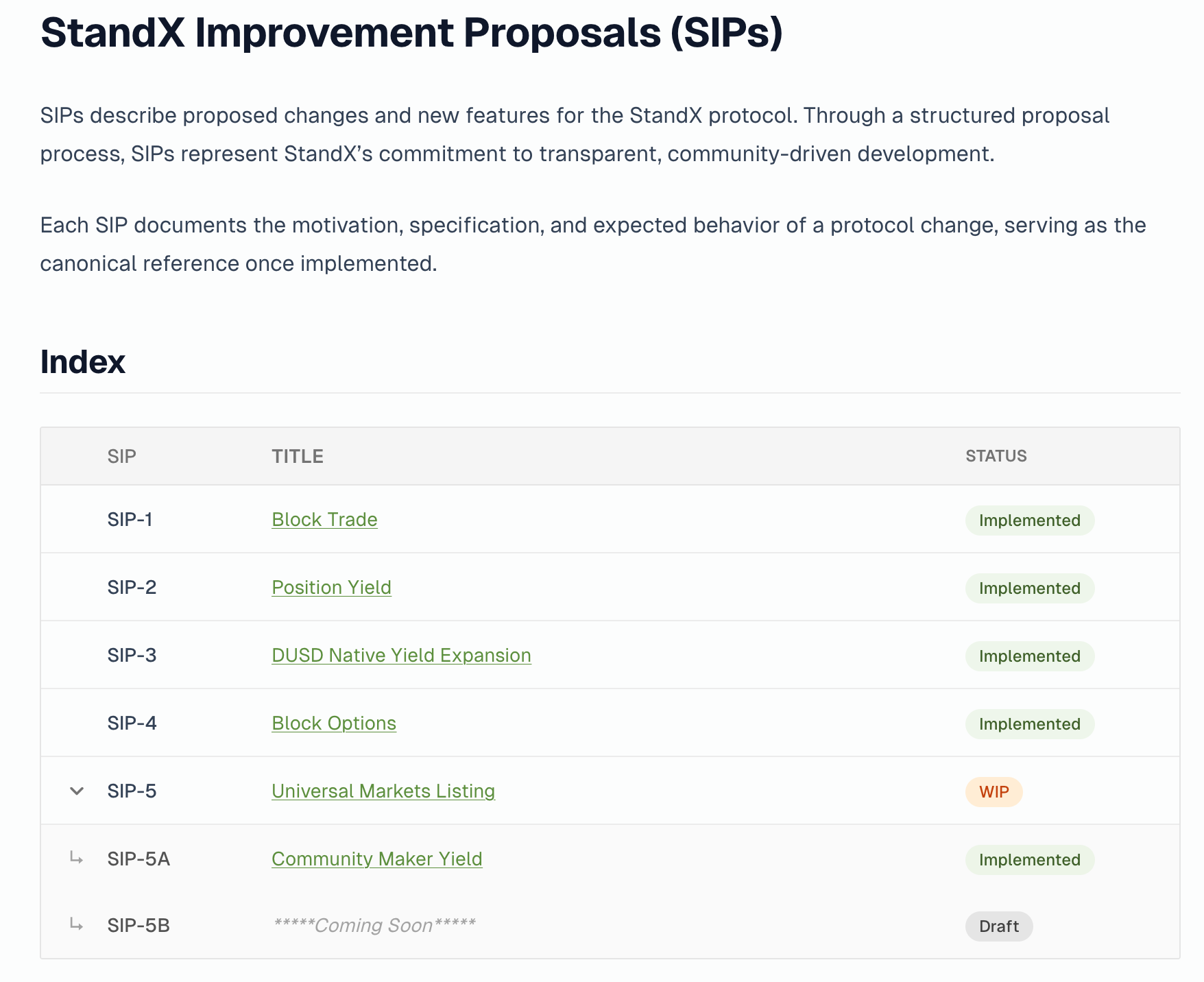
Conclusion first: not one of the SIPs below has a precedent on any other perps platform. Every one is a first. None is a copy. Together they do one thing: pull the three kinds of people in a market (holder, taker, maker) into the yield loop, one by one. That is Universal Yield.
| SIP | For whom | What it does | What it pioneered |
|---|---|---|---|
| SIP-1 Block Trade | trader | Match on BNB Chain / Solana, settle on StandX | Every platform matches and settles on itself; nobody had connected the chains people already use |
| SIP-2 Position Yield | trader | Fees flow back; an open position earns | The first time a trader went from only paying to getting paid |
| SIP-3 DUSD Native Yield | holder | Fees flow back; holding DUSD earns more interest | The first stablecoin to share the fees of an entire trading system |
| SIP-4 Block Options | trader | The first onchain options settled by perps, p2p, fully transparent | The first complete toolkit for protecting a position on chain |
| SIP-5A Community Maker Yield | maker | Provide real liquidity, get paid daily in DUSD / platform token | The first time market making yield opened to the community, not institutions only |
| SIP-5 Universal Markets | holder + taker + maker | Anyone can open a market | Scales all of the above to 1,000,000 markets |
One by one.
With SIP-1 we filled a blank every platform had left open: nobody was connecting to the on-chain infrastructure people already use. Hyperliquid, Aster, and Lighter all took the other road and built their own L1 settlement chains. The chain architecture I agree with. Building your own settlement chain, I believe, is wrong, because it forces users to split their money one more time. You have 100 dollars in your pocket. One more chain in the world does not make it 150 dollars. It just means less money on every chain.
SIP-1 goes the other way. No new kingdom; strengthen the chains that already exist. For the first time, users on BNB Chain and Solana can openly show trading intent on the chain they already live on, match with any counterparty, and let StandX settle it. Think of a classifieds marketplace: post what you have or what you want, pick your own counterparty, and the platform walks the trade safely to the end. For the first time, transactions on the source chain can talk directly to a chain-native perps venue. Beyond the CLOB, the chain gains one more way to get a fill.
SIP-2 and SIP-3 do the same thing: give fees back to the market. SIP-2 is for traders, where an open position collects money. SIP-3 is for holders: on BNB Chain, on Solana, or inside perps, holding DUSD means more interest. On other platforms, a fee that enters the platform’s pocket never comes out. On StandX, fees are income for everyone participating.
SIP-4 builds on SIP-1 and delivers the first onchain options settled by perps. Peer to peer, fully on chain, fully transparent. For the first time a trader has a complete strategy for protecting a position on chain, instead of just the two buttons of take-profit and stop-loss.
SIP-5A turns market making from an institutional privilege into everyone’s business: put real liquidity on the book, collect DUSD and platform tokens every day. It does not count wash volume. It counts depth that can actually be hit.
Finally, SIP-5 Universal Markets scales all of it through permissionless listing: anyone can open a market if it meets the public rules, and no one’s approval is needed. Perps, spot, prediction, and pre-market all live inside this framework. Holders gain a million new sources of yield, takers a million new markets to trade, makers a million new books to earn on.
At SIP-5 the loop closes. A sponsor takes an asset slot with DUSD and opens a market, funds a Reward Vault to pay makers, funds a Shield Vault to buffer extreme liquidations. Makers come for liquidity. Traders come to trade. Fees return to the sponsor, DUSD holders, position traders, and makers. Good markets stay. Bad markets go reduce-only, sunset, and delist, all in the open.
The permissionless we are building is simple: not the absence of rules, the absence of privilege.
It is not a free-for-all. Where the oracle comes from, how liquidation works, how longs and shorts are protected, what triggers reduce-only, what triggers delisting: all of it written down in public rules, stricter than most exchanges. What it actually removes is the invisible hand outside the rules: the listing committee, the connections, the platform’s preferences.
Traditional exchange listing is rule by people. Who gets listed, when, and at what price is decided in that important and mysterious meeting room.
Universal markets are rule by law. In front of the rules, every asset is equal. Meet the rules and you go for listing, no one’s nod required. Cross the red line and you exit transparently, no exceptions either.
Which gives us a self-reinforcing loop (I refuse to say flywheel, everyone in crypto says flywheel, the word has gone cheap): higher and steadier DUSD yield brings more DUSD. More DUSD carries more markets and more volume. More volume produces more fees. Fees flow back to traders, holders, and makers, and push DUSD yield higher and steadier again.
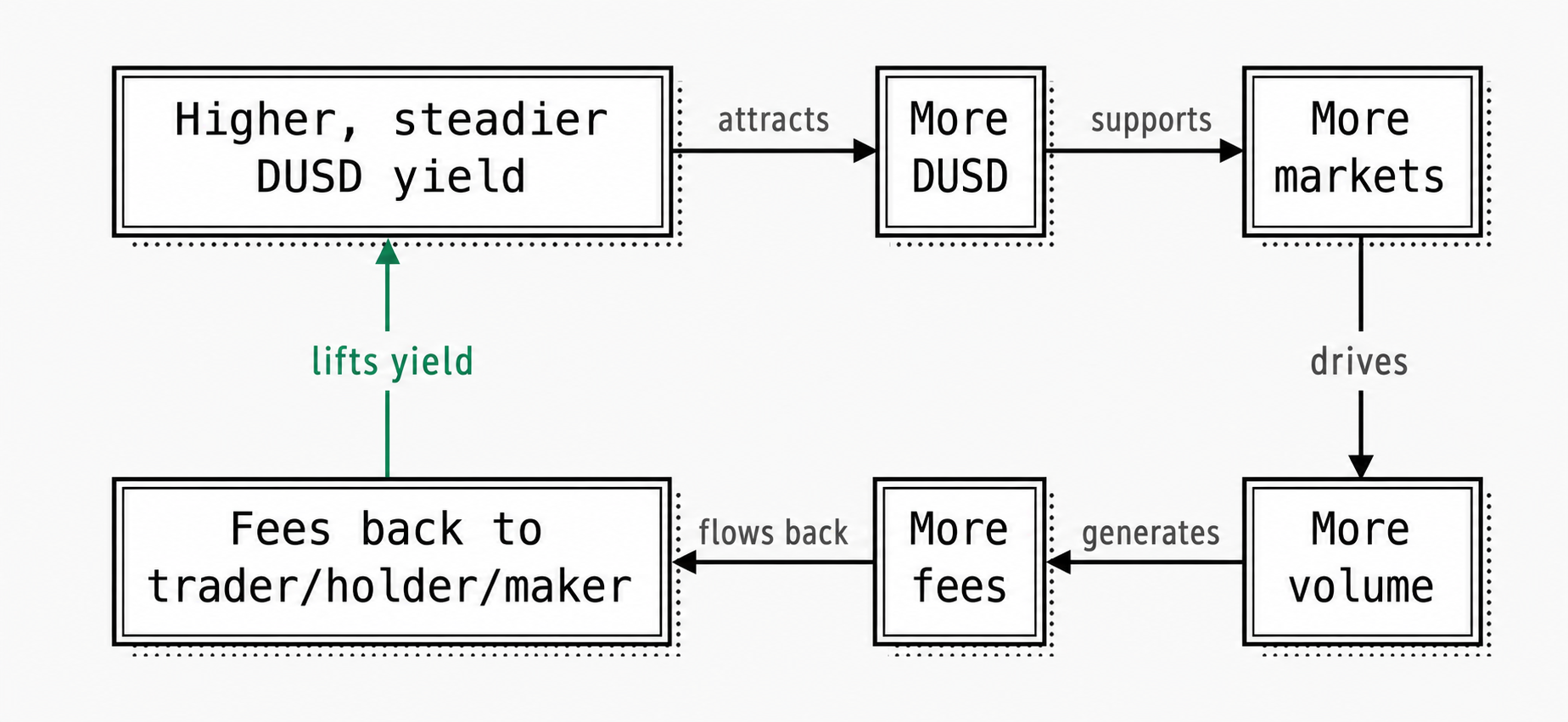
The end point of this loop is 1,000,000 universal markets.
Why the UI Had to Be Rebuilt Too
We rebuilt the UI because StandX will not be serving 10 mainstream pairs forever. A trading system facing 1,000,000 universal markets needs to show completely different things.
The core of a traditional perp UI is chart, order book, order panel, positions. For mature markets like BTC and ETH, that is enough. In a universal market, price is not all a user needs. They need to know: who sponsors this market? Is the Reward Vault sufficient? Can the Shield Vault absorb an extreme liquidation? How is maker yield calculated? Where does DUSD yield come from? Does my position qualify for position yield? Is this depth real, or does it just screenshot well?
So the goal of StandX’s UI is concrete: make trading more transparent. A trader opens a market and sees their margin, position, yield, and risk clearly. A maker enters a market and sees the reward rules and depth requirements clearly. A sponsor launches a market and sees the vaults, fee routing, and market status clearly. Every role revolves around the same market page, no longer scattered across campaign pages, docs pages, and hidden rules.
Our current UI is definitely not perfect yet. But the direction is clear: for 1,000,000 universal markets, the trading interface has to go from an order ticket to a market operating system. This road is harder, and easier to get yelled at on. That is fine. If something is wrong, we fix it. When it truly runs, today’s unfamiliarity becomes the new habit.
Who Exactly are the StandX Team
StandX has no VCs. Everything is self-funded, and we reached roughly $700M daily volume, 235K users, and the top ranks of DeFiLlama’s perps board. In an industry that scales on capital and subsidies, I know of very few teams that walked to this position fully self-funded.
That cannot all be luck. We care a lot about fundamentals. On this team:
- BSC MEV top 1, ETH Mainnet MEV top 3. MEV is an arena scored in real money; that understanding of on-chain systems and that engineering skill were verified by the market, with real money.
- Writing an EVM compiler back in 2022. When most people had not even heard of Huff, he was already building a language on raw opcodes.
- Database internals, fixed-point math, big-number structures, CPU clock-level optimization. StandX’s matching and settlement are measured in clock cycles.
- An informatics olympiad champion who can single-handedly max out the quota on every AI account we own.
- A polymath who covers gateway, frontend, backend, devops, music, and visual design, all by himself. His only flaw: whatever the timezone, he shows up at 1am.
Two people left a deep mark on me when they joined. One ended his lease, stuffed everything he owned into his car, drove south, and parked downstairs at the office. The other drove 500 kilometers with a folding cot, saying he could just sleep in the office if needed. His car ended up parked next to a dumpster, rats moved in, and the stench was unbelievable. The repair shop stripped the whole car and aired it out for two months, and the smell still would not leave, so in the beginning he really did sleep in the office. They follow their judgment, not the wind.
The years spent writing compilers, matching engines, and databases did not depreciate in the AI era. They are paying out double. AI made writing code fast, but the people who truly know how a system works, where the boundaries are, and how to optimize the critical path are scarcer and more valuable than ever. Which is why we dare to say: any product we want to build, we can build.
Put a group like this together and there is no way they settle for building the 100th copy of a perp DEX. A latecomer who builds exactly what others built ends up dragging the competition outside the product: capital, channels, operations, subsidies. Those all matter, but they cannot answer the question we actually care about: why has the right to open a perpetual market still not been handed back to the market?
StandX starts from DUSD, from yield, from makers and sponsors, and takes that question apart layer by layer, making each piece real. Not for 500 pairs. To open 1,000,000 universal markets.
Not the 100th Hyperliquid. The First StandX
Plenty of perps DEXes benchmark themselves against Hyperliquid. They may execute well, but benchmarking carries a fate: you can never surpass the thing you benchmark. It moves, you move. Its today is your tomorrow, and your best ending is a later version of it. Like a defender on the court: the opponent has already finished the turn in his head, and you react only when his body moves, forever those few steps behind.
“Only today do I know that I am me.”
StandX will only ever become StandX. We do not chase the wind. We intend to be the wind, by solving ahead of time a problem that is certain to arrive: listing, liquidity, yield, risk, and fee routing for on-chain derivatives markets, organized by the market itself for the first time. The path is Universal Markets. The fuel is Universal Yield. The goal is opening 1,000,000 universal markets.
StandX wants every asset to own its own market, more freely.
Projects no longer queue and wait for an exchange to flip their card; meet the rules and open your own market. Makers no longer need connections to land a market making deal; put real liquidity on the book and income arrives daily. Traders are no longer just the ones paying fees; the position itself earns. Even the DUSD sitting in your wallet shares the value grown by 1,000,000 markets.
Uniswap handed the right to create spot markets back to the market, and four hundred thousand pools grew on ETH mainnet, with over a million on BSC. Pump.fun handed the right to issue assets back to the market, and eighteen million assets followed. Every time the right is returned, the scale jumps by orders of magnitude.
Perpetuals are the last and largest piece of this return. This time, it falls to StandX.
The next generation of trading venues will not compete on who lists more. They will compete on who lets markets grow on their own. That is not a prediction. It is history that has already happened twice. The rules are written. The foundation is earning. The order is in place. What remains is for the market to pour in.
Don’t be a follower.
Be a Stander.