Orderbook, ALO, Maker Points — A Trader’s Field Notes on StandX
1. Limit Orders Can Act Like Market Orders in Fast Moves
On BTCUSD, during fast candles, some of my limit orders did not behave like I expected, they filled immediately with noticeable slippage and higher fees.
Technically they were limit orders, but in practice they behaved very close to market execution. This mostly happened during volatility spikes.
What helped:
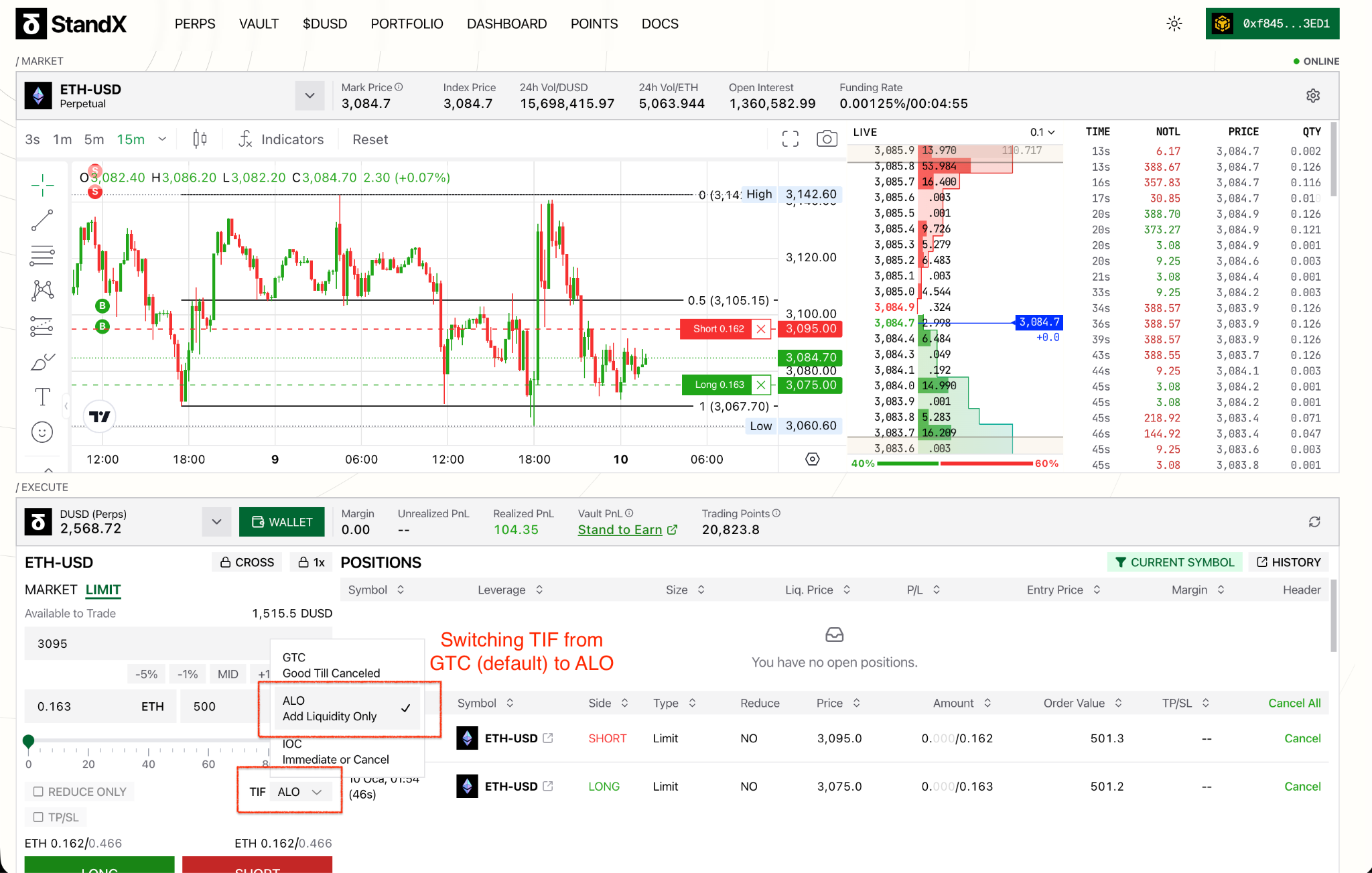
When placing limit orders, enabling Add Liquidity Only (ALO) prevents this, by default, Good Till Canceled (GTC) is chosen. Switch to ALO to avoid surprises.
After ETHUSD was added, this became even more visible. ETH tends to move faster than BTC, and without ALO, limit orders were more likely to be filled aggressively during sharp moves. Using ALO on ETHUSD made the orders either stay passive or don’t execute at all. Execution quality improved and taker fees were avoided.
I also noticed this becomes more costly around funding windows, where unintended market fills slightly shift entry price and size, reducing liquidation buffer and increasing funding impact.
This also ties directly into the newly introduced Maker Points system.
2. Why This Matters for Maker Points
Passive orders placed with ALO now serve a dual purpose, protecting execution quality while contributing to liquidity incentives without forcing unnecessary fills.
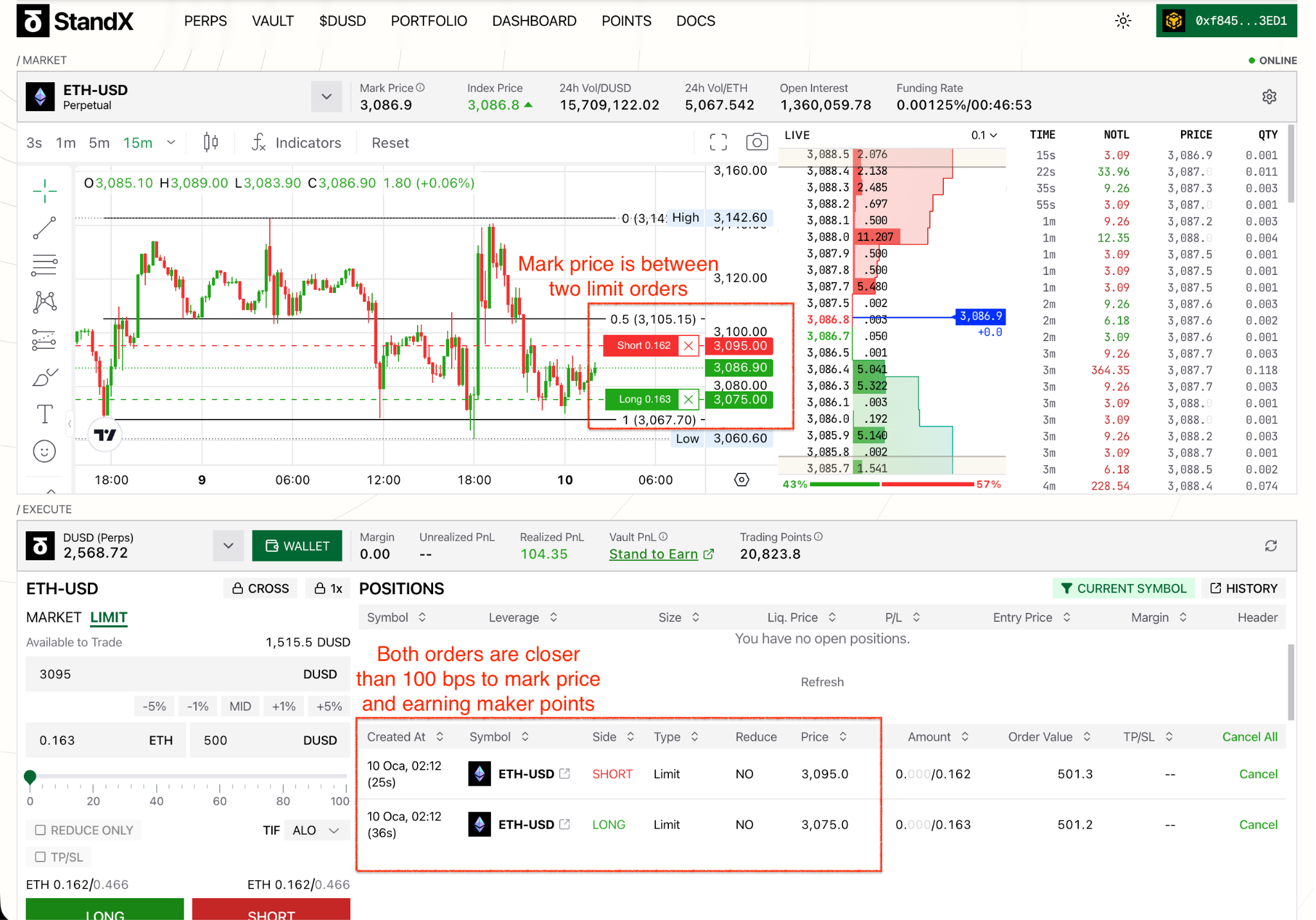
Keeping passive limit orders close to the current price not only improves execution control and fee efficiency, but now also earns Maker Points even if the order is not filled.
Maker Points are calculated based on three parameters:
- Order value: Defined as margin multiplied by leverage.
- Order duration: Continue to accumulate for as long as the order remains active on the orderbook, 24 hours receive 1/1 weighting, while 1 hour gets 1/24.
- Distance from the current market price: Orders placed within 0-10 basis points (0-90 USD when BTC is 90000 USD) receive full weighting, those within 10-30 basis points receive %50 weight, and orders placed 30-100 basis points away contribute as %10. Beyond this range, the impact becomes ineligible.
This structure reinforces disciplined limit placement, size alone is not enough, distance and patience determine whether an order meaningfully contributes to liquidity or simply occupies space.
3. Temporarily Reduced Orderbook Depth and Its Impact on Liquidity
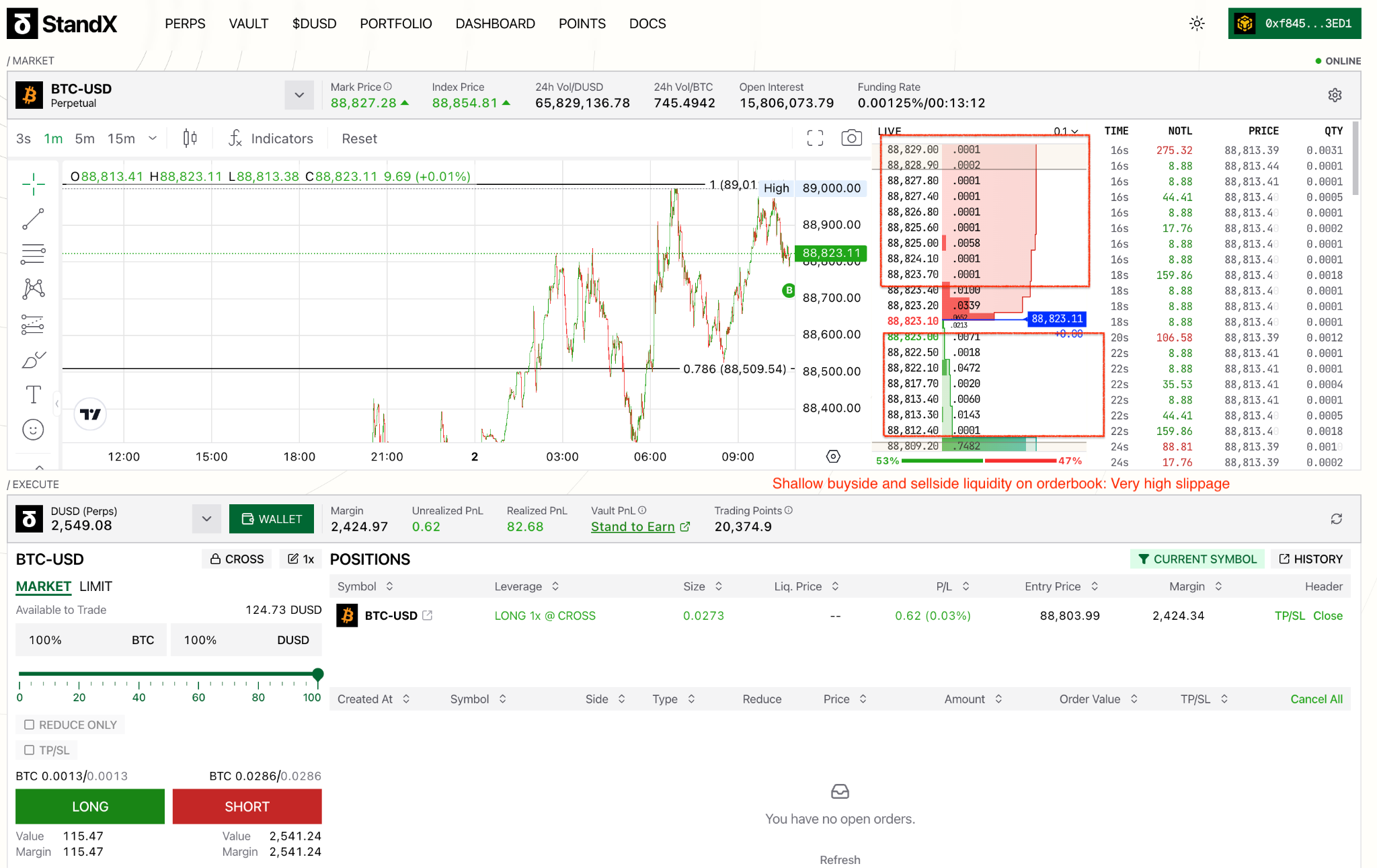
Especially after big movements, orderbook tends to be thinner compared to session norms.
This can lead your market order to sweep all bids/asks written in the orderbook until it fulfills.
In example below:
The mark price might seem as 88823, but if i open a short position larger than 0,05 BTC or close my long position in the same size, i will end up filling all orders to 88812 level.
Checking the history panel and seeing my order actually filled at a much worse average level with lesser PnL than expected leads to disappointment.
To avoid this, always calculate if liquidity efficiency can buffer your market order.
4. DCA Is Not the Problem, Undefined DCA Is.
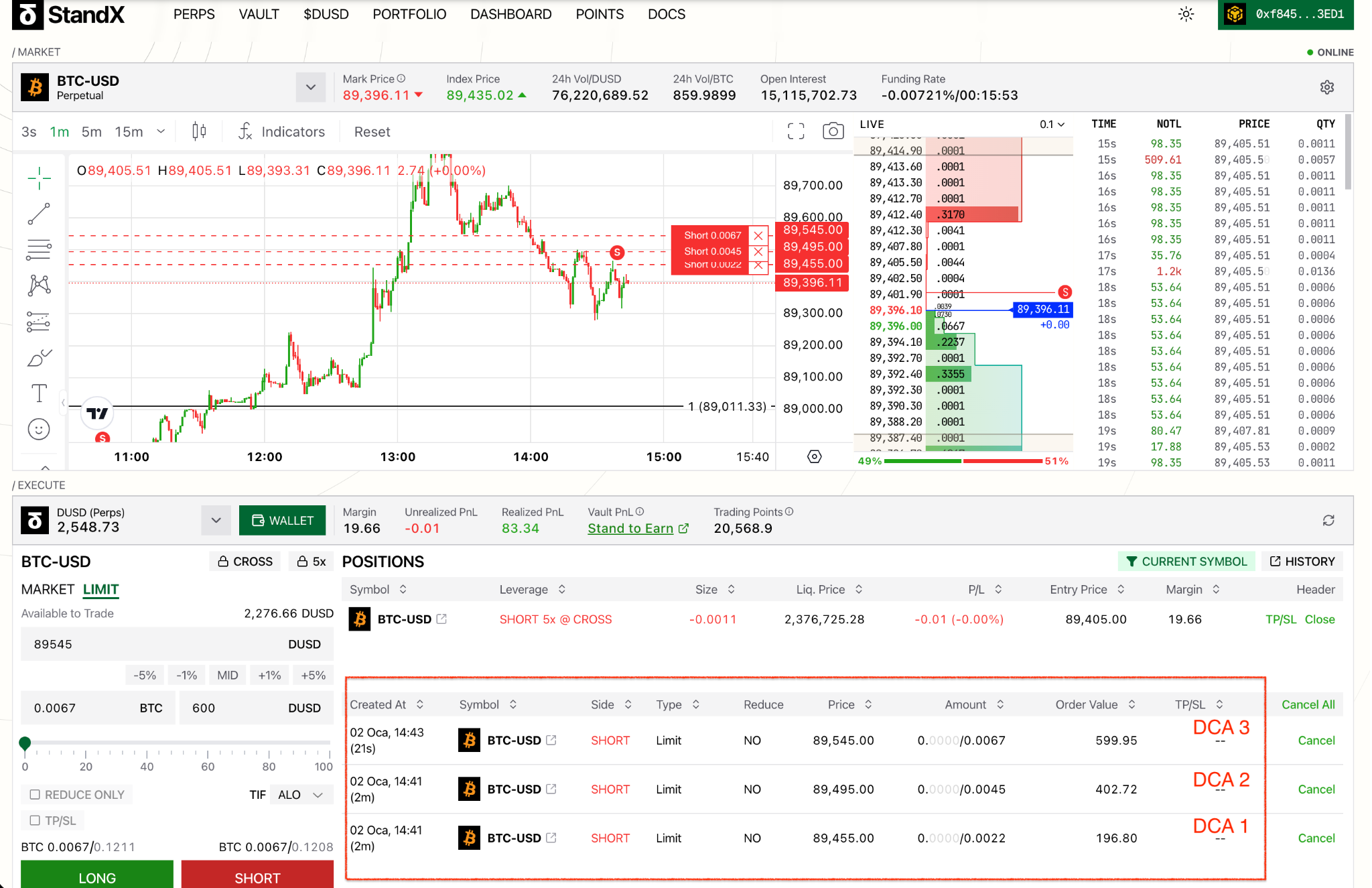
Dollar Cost Averaging (DCA) itself is not dangerous.
The real problem starts when there is no clear point where DCA must stop.
On leveraged positions, adding again and again slowly increases exposure without being obvious at first.
This usually ends with a much bigger loss than planned.
What I do now:
Before entering, I already know where DCA ends.
If that level is reached, no more adds. NO EXCEPTIONS.
This simple rule reduced damage on losing trades significantly.
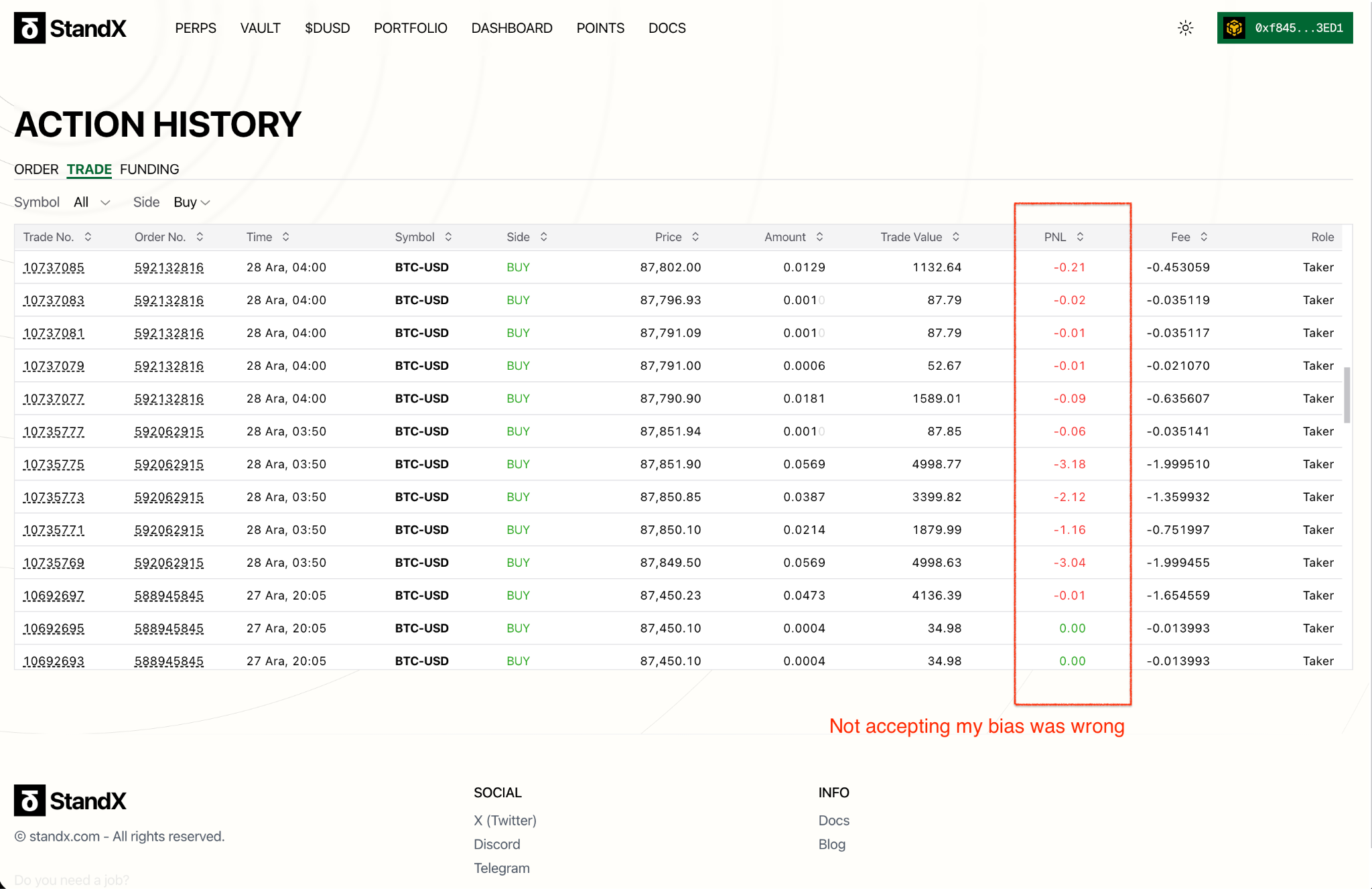
Most losses are psychological, not liquidations.
In my experience, real liquidations are rare.
Most damage happens before that.
After a loss, the urge to recover fast is strong.
That’s usually when leverage goes up and discipline goes down.
5. Fixed TP and SL Levels Are Actually Helpful
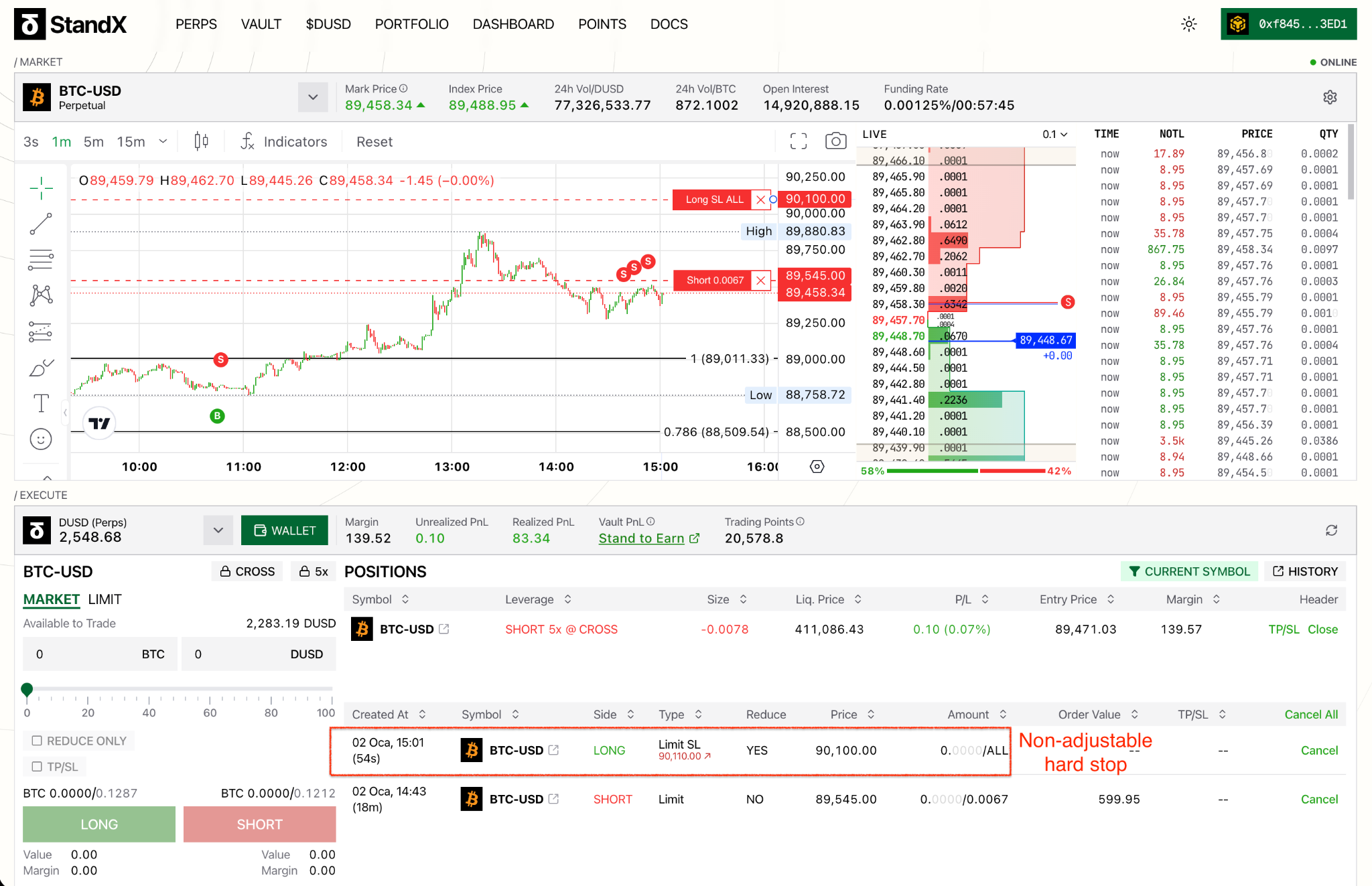
On StandX, TP and SL levels cannot be freely adjusted after opening the position.
At first, this feels limiting.
But over time, I noticed it prevents emotional stop manipulation.
Dragging stops or “just adjusting a bit” often breaks the original plan.
What works better:
If a trade fails cleanly, the session ends.
The market will still be there tomorrow.
Trying to fix today’s loss today creates a bigger one.
Accepting predefined outcomes improved consistency and reduced impulsive decisions.
Final Thoughts
Execution details matter more than most people think.
Understanding how orders really behave on StandX makes a real difference.
These notes are based only on my own executions.