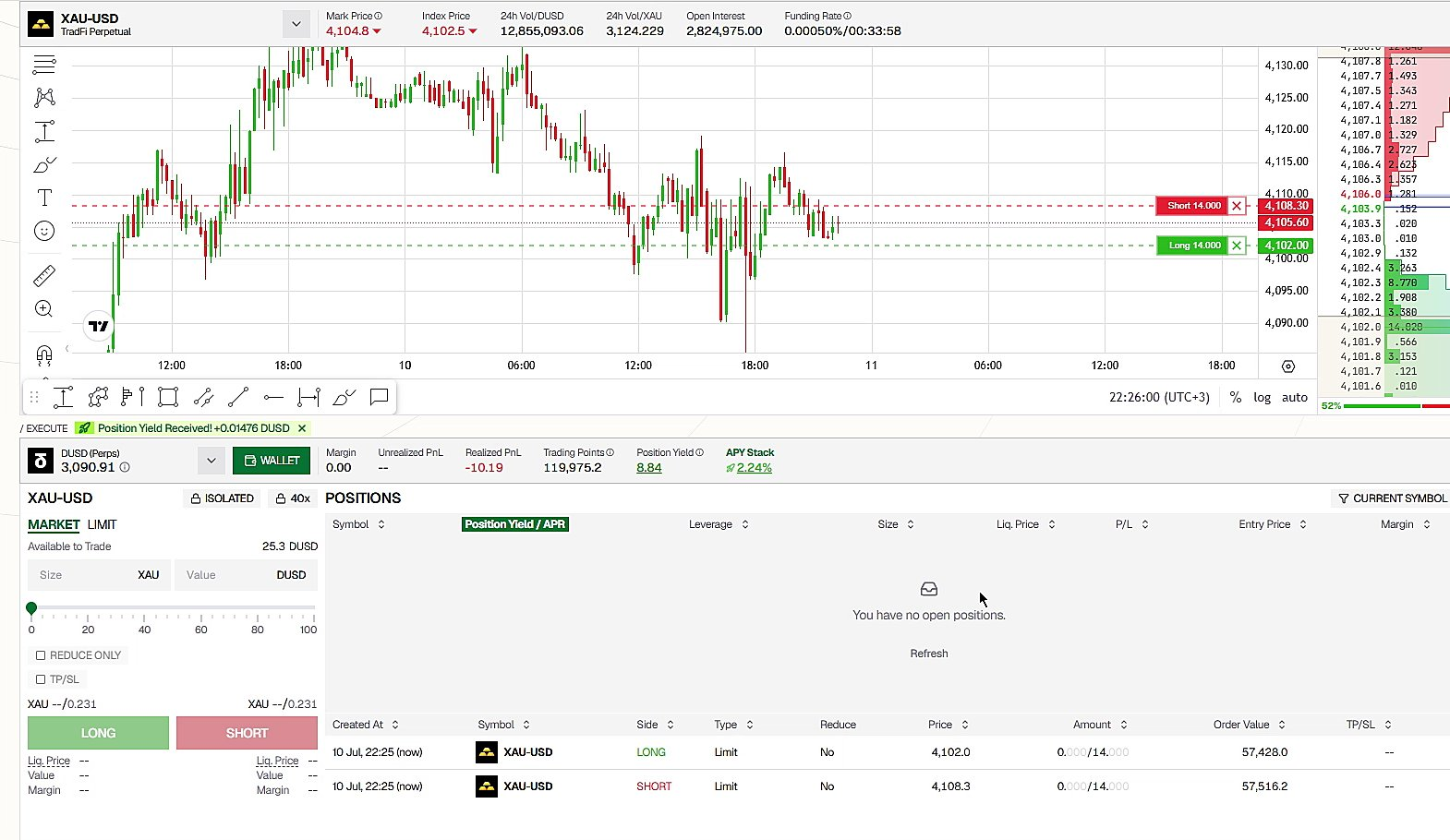
⬆ The 14 XAU buy and 14 XAU sell limit orders I kept active at the same time on the XAU-USD order book.
I placed real 14 XAU limit orders on both the buy and sell sides of the XAU-USD order book. At the moment shown in the video, each order was worth roughly 57,500 DUSD, putting the combined two-sided order size at around 115,000 DUSD.
When I started the bot, I had 5.54 Maker Hours and 10.48 DUSD in SIP-5A Maker Yield. After running it for about 50 hours and 48 minutes, my Maker Hours increased to 28.86 and my Maker Yield reached 47.46 DUSD. Over that period, Maker Hours rose by about 23.32 hours and Maker Yield increased by 36.98 DUSD.
On the Market Maker Points side, I started with 719,081.8108 PTS, while my referral-based Maker Points were 19,045.4 PTS. When I stopped the bot, Market Maker Points had reached 850,550.6845 PTS, the referral bonus was 25,618.9 PTS, and my total Maker Points balance was 876,169.6 PTS.
The bot dashboard shows 22 total orders, 12 cancellations, and 2 fills. After the two fills, realized PnL was -6.20 DUSD and trading fees were 4.209576 DUSD. The total direct cost was approximately 10.41 DUSD.
Daily Rewards with SIP-5A
I was already active in the Maker Uptime program while also accumulating Market Maker Points. My main priority when developing the bot was Market Maker Points. Because I designed it to keep orders active on both sides, close to the mark price, and for extended periods, the same setup also met the Maker Uptime requirements.
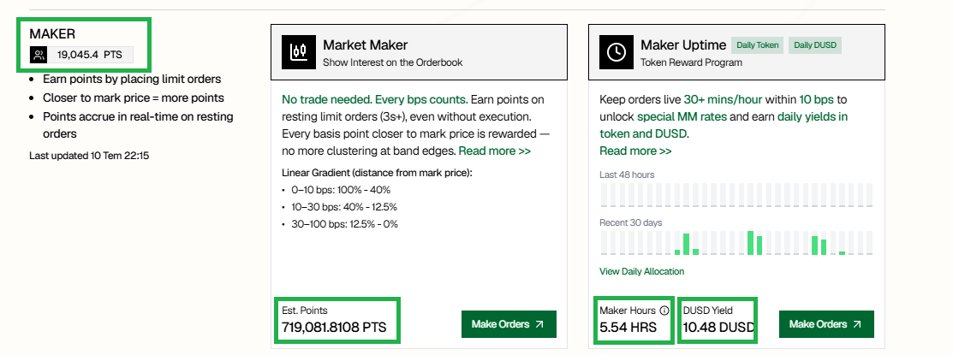
At the moment I started the bot, I had 5.54 Maker Hours, 10.48 DUSD Yield, 719,081.8108 Market Maker Points, and 19,045.4 referral-based Maker Points.
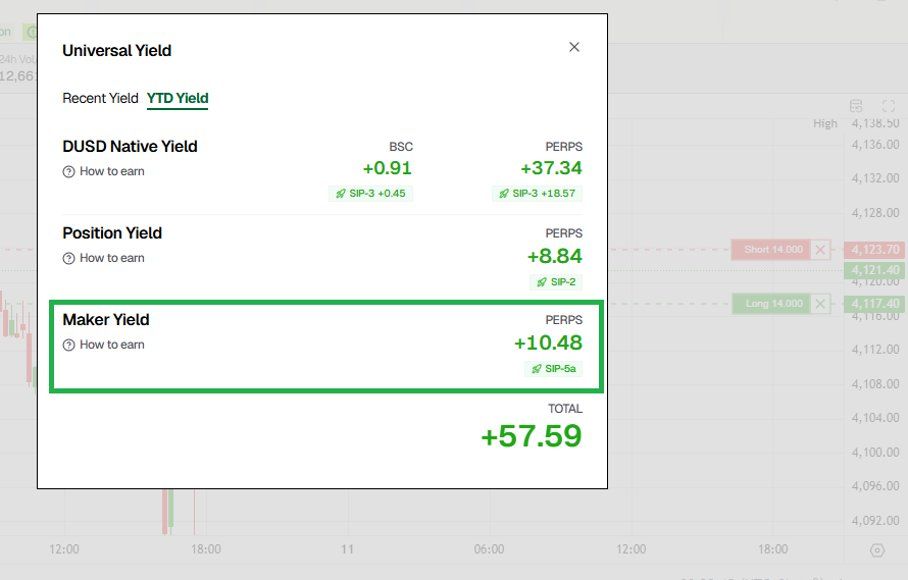
The Universal Yield screen showed an initial Maker Yield total of 10.48 DUSD
How SIP-5A Community Maker Yield Works
SIP-5A rewards makers who provide real, executable liquidity on the order book on a daily basis. To earn Maker Hours, active orders must be present on both the buy and sell sides at the same time, remain within the eligible distance, and satisfy the required duration within the hour.
Under the current campaign rules, orders must stay within 10 bps of the mark price and remain eligible for at least 30 minutes within an hour. Thirty minutes qualifies for the Standard level, while 42 minutes qualifies for the Boosted level. Standard receives a 0.5x uptime multiplier and Boosted receives 1.0x. Distance from the mark price is also evaluated through a separate proximity weight.
Maker Hours accumulate throughout the day. When the daily epoch closes, the reward pool is distributed among eligible makers in proportion to the Maker Hours earned that day. For this reason, there is no fixed DUSD or allocation amount per Maker Hour. Results can change as the daily pool size, total participant Maker Hours, and market weights change.
How My StandX Maker Bot Works
The bot tracks the mark price continuously. When the Near profile is selected, it places a buy limit order roughly 7 bps below the mark price and a sell limit order roughly 7 bps above it. The orders remain active while price stays within the operating range I set. When the mark price moves far enough, the bot cancels the old orders, recalculates the price levels, and places new orders on both sides. I use the terms long and short, but technically these are limit orders placed on the buy and sell sides of the order book. They are not fake orders or orders placed at unreachable levels. If price reaches them, they can be filled. This means the bot can create an open position, trading fees, funding, and closing costs from TP or SL.
In the video, the XAU-USD mark price is around 4,104.8 DUSD, while the buy order is shown at 4,102.0 and the sell order at 4,108.3. Although the target is 7 bps, it is normal for the displayed distance not to be identical on both sides. The mark price continues to move after the orders are placed, and order prices are rounded according to the market’s tick size.
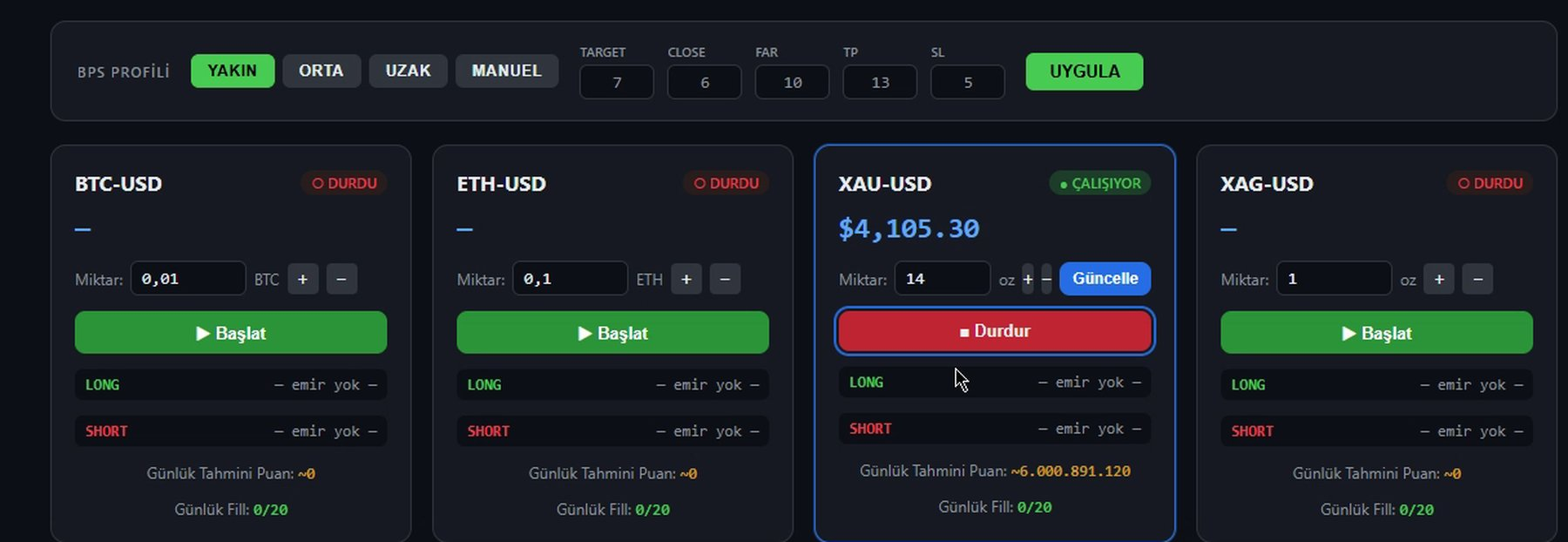
The screen where I selected 14 XAU for XAU-USD and started the bot with the Near profile.

The bot’s 14 XAU buy and 14 XAU sell limit orders are active on the StandX order book

The Near profile settings I use on weekends: Target 7, Close 6, Far 10, TP 13, and SL 5 bps.
Why I Use XAU-USD on Weekends
I run the bot on XAU-USD mainly on weekends because price movement can be more limited than during weekday sessions while traditional global gold markets are closed. During the weekend covered here, I had to refresh the orders less often than I normally do during the week.
During active weekday sessions, gold can move more frequently and produce sharp wicks. When the mark price changes quickly, the bot cancels the old orders and places new ones at updated levels. This keeps the orders close to the order book, but it can interrupt continuous Maker Uptime.
During the quieter weekend hours, my buy and sell orders were able to remain active for more than 30 minutes. This made it easier to accumulate Maker Hours. I do not treat this as a fixed market rule. XAU-USD can still move on weekends, orders can be filled, and open-position risk remains.
Why I Use 7 BPS in the Near Profile
A distance of around 7 bps is relevant to two parts of the system. In the Market Maker Points program, the 0-10 bps range is the highest-weighted band. Weight increases linearly as the order moves closer to the mark price. The 0-10 bps band declines from 100% to 40%, the 10-30 bps band from 40% to 12.5%, and the 30-100 bps band from 12.5% to zero.
For SIP-5A, 7 bps leaves a small buffer inside the 10 bps limit. Because the mark price moves continuously, placing an order directly at the boundary can push it outside the eligible range after even a small price move. Seven bps reduces that risk, but moving the order closer to price also increases the chance of a fill.
RISK NOTE Closer orders can offer an advantage for both points and Maker Hours. The same proximity also raises the probability of execution. Choosing a BPS distance is a balance between rewards and market risk.
How Maker Hours and Eligible Hours Accumulated
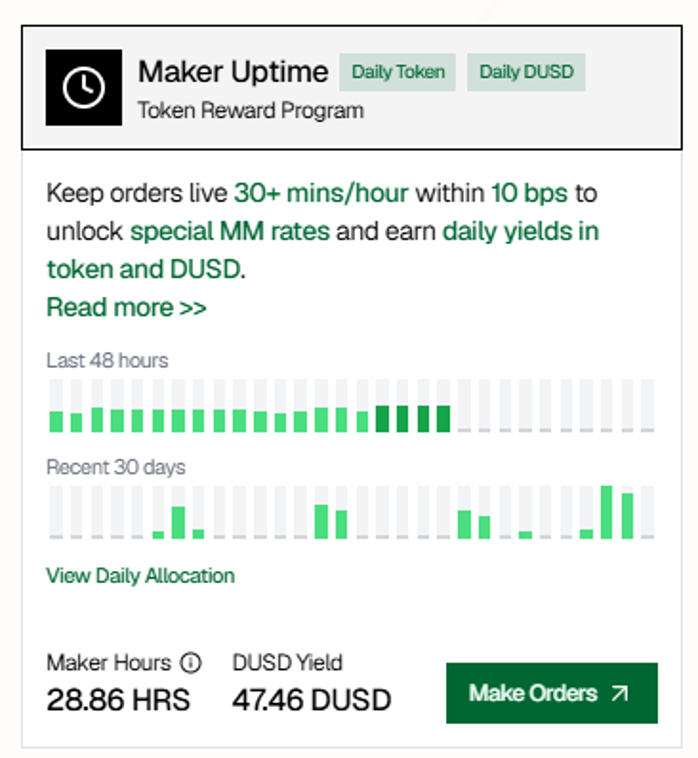
The bot maintained orders on both sides and used the Near profile to remain within the 10 bps eligibility range. When both sides stayed active for the required duration within an hour, the system calculated that contribution as Maker Hours. The daily settlement screen displays this duration under Eligible Hours. Some hourly blocks on the chart appear light green and others dark green. Dark green means the calculated Final Maker Hours value is above 0.50. Light green means the Maker Hours value is above zero but equal to or below 0.50. The colors do not directly represent the uptime percentage.
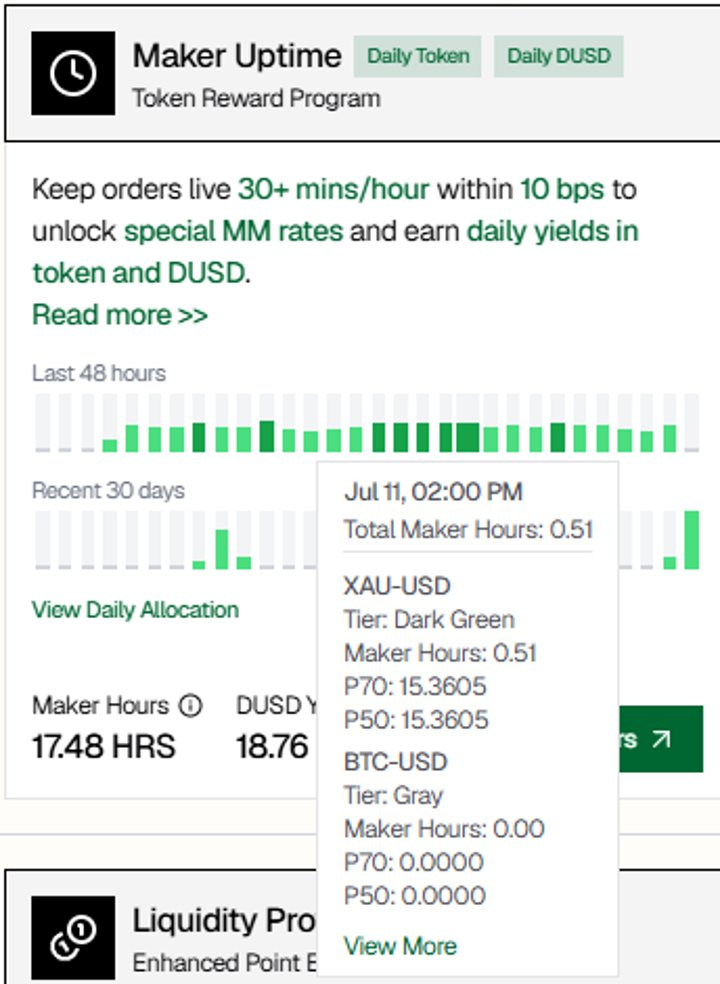
The 2:00 PM block is dark green because Maker Hours reached 0.51 for that hour.
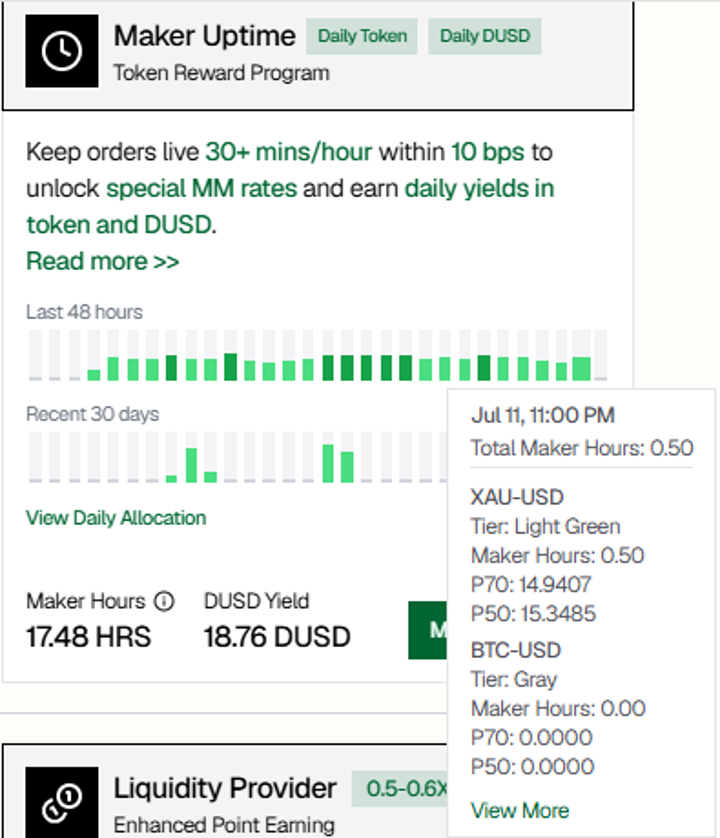
The 11:00 PM block is light green because Maker Hours was exactly 0.50 for that hour.
My First DUSD Settlement Records
My initial SIP-5A screen showed 5.54 Maker Hours and a total of 10.48 DUSD in Maker Yield. In the first two daily records, July 5, 2026 showed 5.02 Eligible Hours and 7.76 DUSD on XAU-USD, while July 7, 2026 showed 0.51 Eligible Hours and 2.72 DUSD.
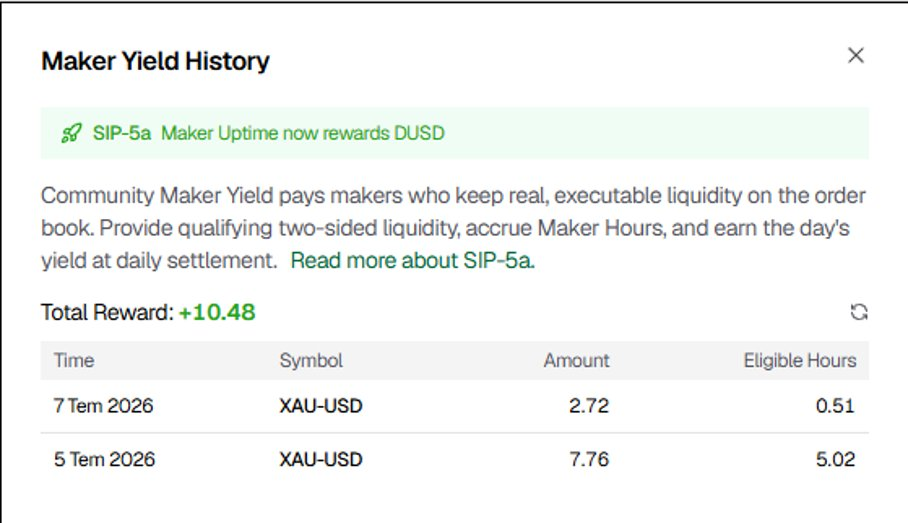
The Maker Yield History screen shows 5.02 Eligible Hours and 7.76 DUSD for July 5, and 0.51 Eligible Hours and 2.72 DUSD for July 7.
From Monthly Allocation to Daily Distribution
Before SIP-5A, the Maker Uptime system operated on a monthly basis. Each month, a pool of 5 million platform token allocation was distributed according to the Maker Hours accumulated.
In my earlier monthly results, April 2026 recorded 1,936.32 allocation for 4.38 Eligible Hours, May recorded 12,207.61 allocation for 26.11 hours, and June recorded 11,658.34 allocation for 30.55 hours.
These allocation values are not DUSD or Maker Points. Since the StandX platform token has not yet been launched, the rewards are recorded in the account as allocation entries. The actual distribution date will depend on the token launch schedule. Under SIP-5A, allocation records became daily and daily DUSD Maker Yield was added alongside them.
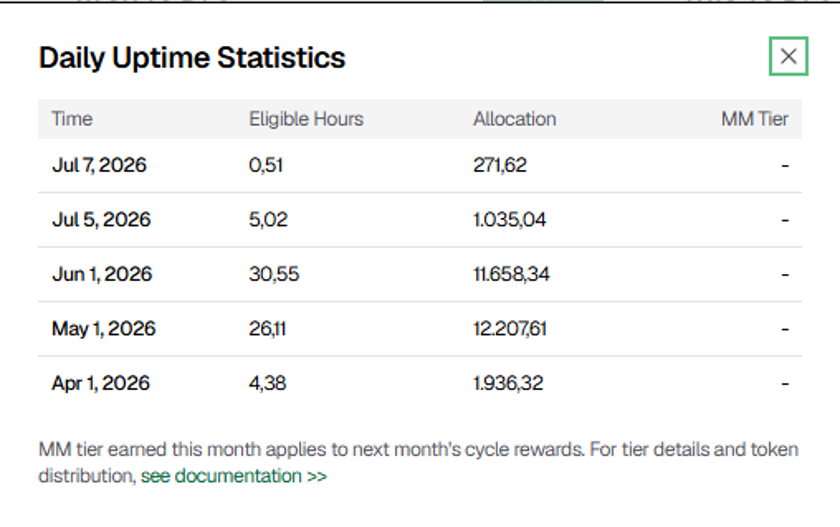
My allocation records for April, May, and June, followed by the daily SIP-5A records for July 5 and July 7.
After 50 Hours and 48 Minutes
When I stopped the bot, my total Maker Hours for July had reached 28.86 and my SIP-5A Maker Yield balance had reached 47.46 DUSD. Compared with the starting values, Maker Hours increased by about 23.32 hours and Maker Yield increased by 36.98 DUSD.
The daily allocation screen shows 5.02 Eligible Hours and 1,035.04 allocation for July 5; 0.51 hours and 271.62 allocation for July 7; 2.10 hours and 828.02 allocation for July 10; 11.30 hours and 1,518.45 allocation for July 11; and 9.91 hours and 1,351.79 allocation for July 12.
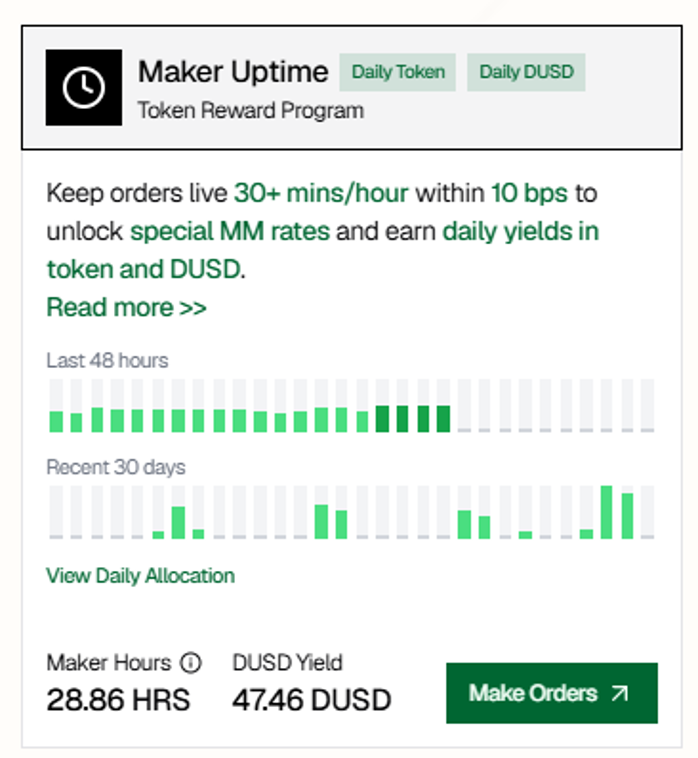
When I stopped the bot, Maker Hours was 28.86 and DUSD Yield was 47.46 DUSD.
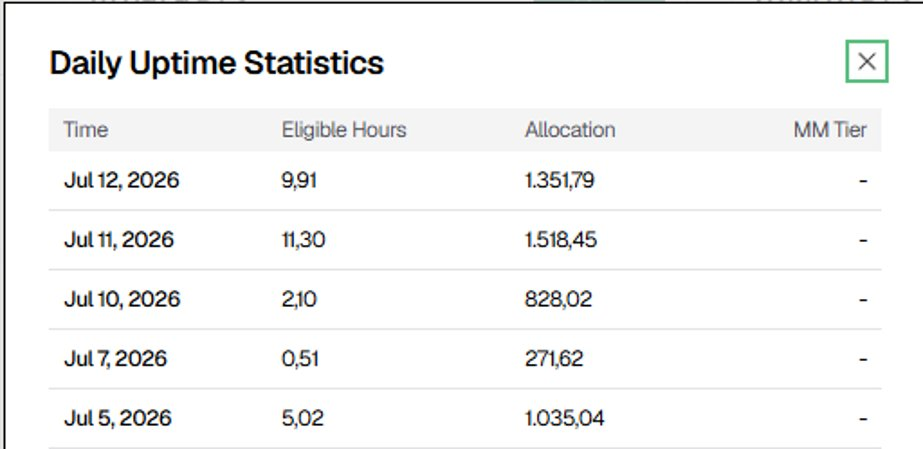
The daily allocation screen lists Eligible Hours and allocation records for July 5, 7, 10, 11, and 12.
My First DUSD Settlement Records
My initial SIP-5A screen showed 5.54 Maker Hours and a total of 10.48 DUSD in Maker Yield. In the first two daily records, July 5, 2026 showed 5.02 Eligible Hours and 7.76 DUSD on XAU-USD, while July 7, 2026 showed 0.51 Eligible Hours and 2.72 DUSD.
The Maker Yield History screen shows 5.02 Eligible Hours and 7.76 DUSD for July 5, and 0.51 Eligible Hours and 2.72 DUSD for July 7.
From Monthly Allocation to Daily Distribution
Before SIP-5A, the Maker Uptime system operated on a monthly basis. Each month, a pool of 5 million platform token allocation was distributed according to the Maker Hours accumulated.
In my earlier monthly results, April 2026 recorded 1,936.32 allocation for 4.38 Eligible Hours, May recorded 12,207.61 allocation for 26.11 hours, and June recorded 11,658.34 allocation for 30.55 hours.
These allocation values are not DUSD or Maker Points. Since the StandX platform token has not yet been launched, the rewards are recorded in the account as allocation entries. The actual distribution date will depend on the token launch schedule. Under SIP-5A, allocation records became daily and daily DUSD Maker Yield was added alongside them.
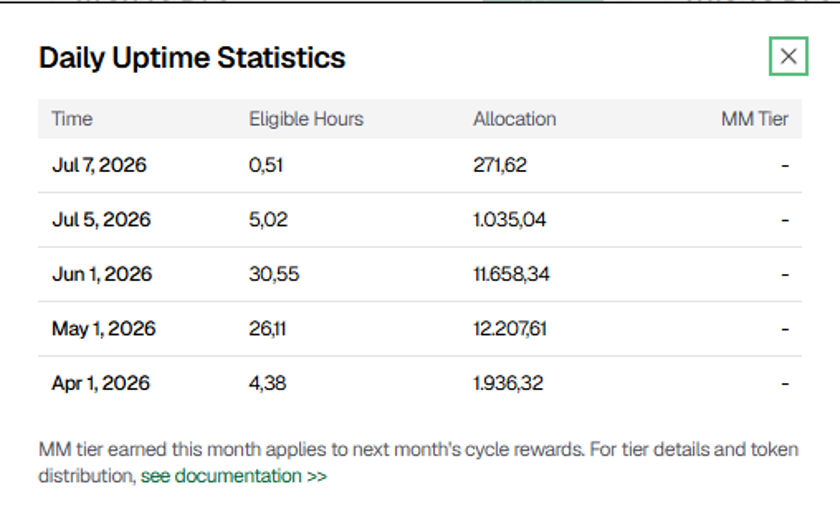
My allocation records for April, May, and June, followed by the daily SIP-5A records for July 5 and July 7.
After 50 Hours and 48 Minutes
When I stopped the bot, my total Maker Hours for July had reached 28.86 and my SIP-5A Maker Yield balance had reached 47.46 DUSD. Compared with the starting values, Maker Hours increased by about 23.32 hours and Maker Yield increased by 36.98 DUSD.
The daily allocation screen shows 5.02 Eligible Hours and 1,035.04 allocation for July 5; 0.51 hours and 271.62 allocation for July 7; 2.10 hours and 828.02 allocation for July 10; 11.30 hours and 1,518.45 allocation for July 11; and 9.91 hours and 1,351.79 allocation for July 12.
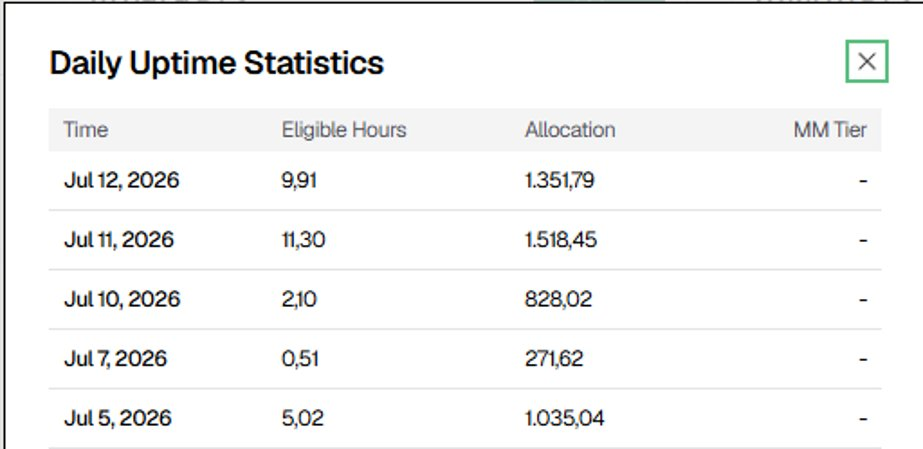
The daily allocation screen lists Eligible Hours and allocation records for July 5, 7, 10, 11, and 12.
Filled Orders and Trading Cost
The bot remained active for a total of 50 hours, 48 minutes, and 22 seconds. During that period, the dashboard recorded 22 total orders, 12 cancellations, and 2 fills. When the market became volatile, two of my limit orders were filled, and the bot managed the position according to the TP and SL ranges I had set.
After the two fills, realized PnL was -6.20 DUSD and trading fees were 4.209576 DUSD. My total direct loss was approximately 10.41 DUSD. Subtracting this cost from the 36.98 DUSD increase in Maker Yield leaves a difference of 26.57 DUSD.
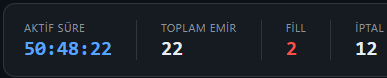
The bot dashboard shows 50 hours, 48 minutes, and 22 seconds of active time, along with 22 total orders, 2 fills, and 12 cancellations.
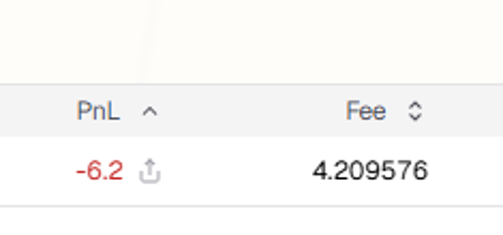
After the two fills, the displayed PnL was -6.20 DUSD and trading fees were 4.209576 DUSD.
My Progress in Maker Points
When I started the bot, Market Maker Points stood at 719,081.8108 PTS and referral-based Maker Points at 19,045.4 PTS. My total Maker Points balance was 738,127.2108 PTS.
When I stopped the bot, Market Maker Points had reached 850,550.6845 PTS, the referral bonus was 25,618.9 PTS, and the combined total was 876,169.6 PTS. Over roughly 50 hours and 48 minutes, Market Maker Points increased by 131,468.8737 PTS, the referral bonus by 6,573.5 PTS, and the combined total by approximately 138,042.4 PTS.
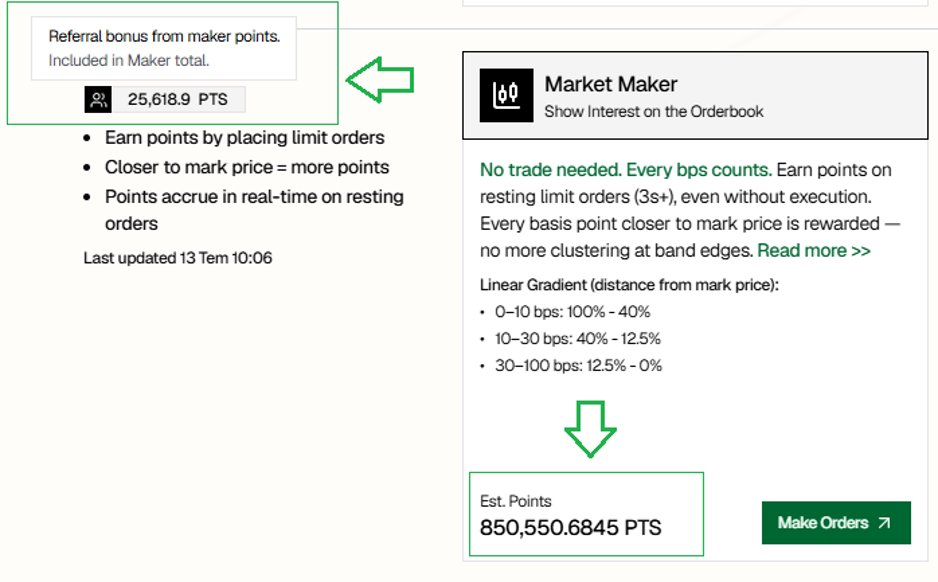
I was 123,830.4 PTS away from my target of one million Maker Points. I plan to reach that target during July. I do not treat these points the same way as DUSD income, since they currently have no fixed token conversion or guaranteed financial value.
Market Maker Points reached 850,550.6845 PTS, while referral-based Maker Points reached 25,618.9 PTS
My total Maker Points balance reached 876,169.6 PTS.
My Current Universal Yield Total
My Universal Yield panel shows a YTD total of 95.15 DUSD. The panel lists 0.92 on the BSC side of DUSD Native Yield, 37.91 on the Perps side, 8.85 in Position Yield, and 47.46 in Maker Yield.
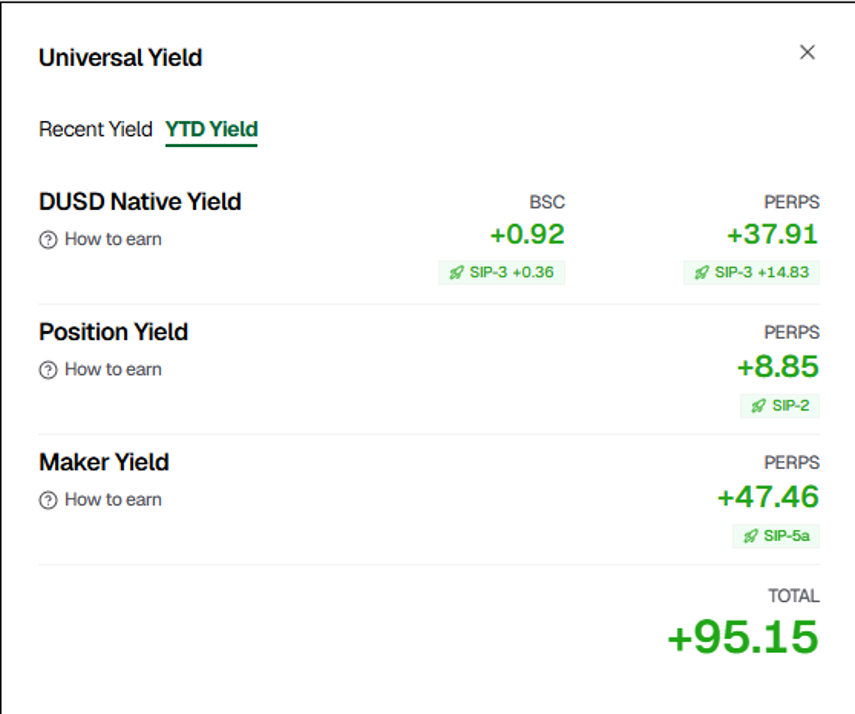
My Universal Yield YTD screen. Maker Yield is 47.46 DUSD, while the combined total across all yield sources is 95.15 DUSD.
Risks I Pay Attention To
· Limit orders placed close to the mark price can be filled more easily and create an open position.
· Sudden price movements, wicks, and spread expansion can create higher-than-expected costs when a TP or SL is triggered.
· Frequent order cancellations and replacements can interrupt Maker Uptime.
· Trading fees, funding, and position-closing costs can exceed the DUSD rewards earned.
· Past results may not repeat in the same way because the daily reward pool and market weights can change.
What the Results Show
By keeping real, two-sided limit orders active on the XAU-USD order book, I accumulated Maker Hours, daily allocation, and DUSD Maker Yield. The Near profile helped me keep the orders inside the 10 bps range for long enough during some hourly periods.
Market Maker Points continued to accumulate during the same period. The two filled limit orders also created a real trading cost. For that reason, I do not treat the 7 bps setting as a fixed or risk-free solution for every market condition, and I do not assume XAU-USD will always remain calm on weekends.
My Overall Assessment
I was already using the bot to accumulate Maker Uptime and Market Maker Points. During the quieter XAU-USD hours over the weekend, I was able to keep my orders active for longer periods.
Over roughly 50 hours, Maker Hours increased by 23.32 hours and Maker Yield by 36.98 DUSD. The two fills created approximately 10.41 DUSD in trading costs. Overall, the bot continued to accumulate both Maker Hours and Maker Points while also generating additional DUSD Yield through SIP-5A.
Data Used
· Market: XAU-USD.
· Order size: 14 XAU on the buy side and 14 XAU on the sell side.
· Combined two-sided order size: approximately 115,000 to 115,380 DUSD.
· Bot runtime: 50 hours, 48 minutes, and 22 seconds.
· Time the bot was stopped: July 13, 2026 at 1:03 AM.
· Starting Maker Hours: 5.54. Final Maker Hours: 28.86.
· Starting Maker Yield: 10.48 DUSD. Final Maker Yield: 47.46 DUSD.
· Bot dashboard counters: 22 total orders, 12 cancellations, and 2 fills.
· Total direct loss shown after the two fills: approximately 10.41 DUSD.
· Final total Maker Points balance: 876,169.6 PTS.
· Universal Yield YTD total: 95.15 DUSD, of which 47.46 DUSD is SIP-5A Maker Yield.