Liquidity Regime Shifts Around Funding Windows on StandX
What Most Traders Miss Before Funding
Introduction - Funding Is Not Just a Transfer
Most traders understand funding as a periodic payment between longs and shorts.
When the rate is positive, longs pay shorts.
When the rate is negative, shorts pay longs.
What often goes unnoticed is this:
Funding does not only transfer value.
It subtly reshapes who is willing to provide liquidity, and when.
On StandX, funding is calculated using the Premium Index and an interest component. The Premium Index itself is derived from impact bid and impact ask prices relative to the price index. This means funding is directly tied to orderbook behavior, not just price deviation.
What traders miss is not the formula.
It is the behavioral shift that happens around funding windows.
1. Mechanism - Why Liquidity Behavior Changes Before Funding
StandX calculates the Premium Index continuously and settles funding periodically. Even though the interest component is hourly, funding behavior tends to cluster around settlement timestamps.
From a market makers perspective:
If one side of the book becomes crowded, for example too many aggressive longs pushing price above index, inventory risk increases.
When funding is positive:
Long positions are incentivized to reduce size.
Short positions are incentivized to maintain exposure.
Liquidity providers reassess inventory balance.
This inventory adjustment feeds directly into impact pricing.
Impact bid and impact ask prices shift as passive size retracts.
That shift influences the premium index calculation itself.
Funding is therefore not external to orderbook behavior.
It is mechanically entangled with it.
This creates a subtle but important shift.
Passive liquidity near the top of the book often retracts or widens shortly before funding settlement.
Not dramatically, not always visibly.
But measurably.
Orderbook depth comparison side by side example:
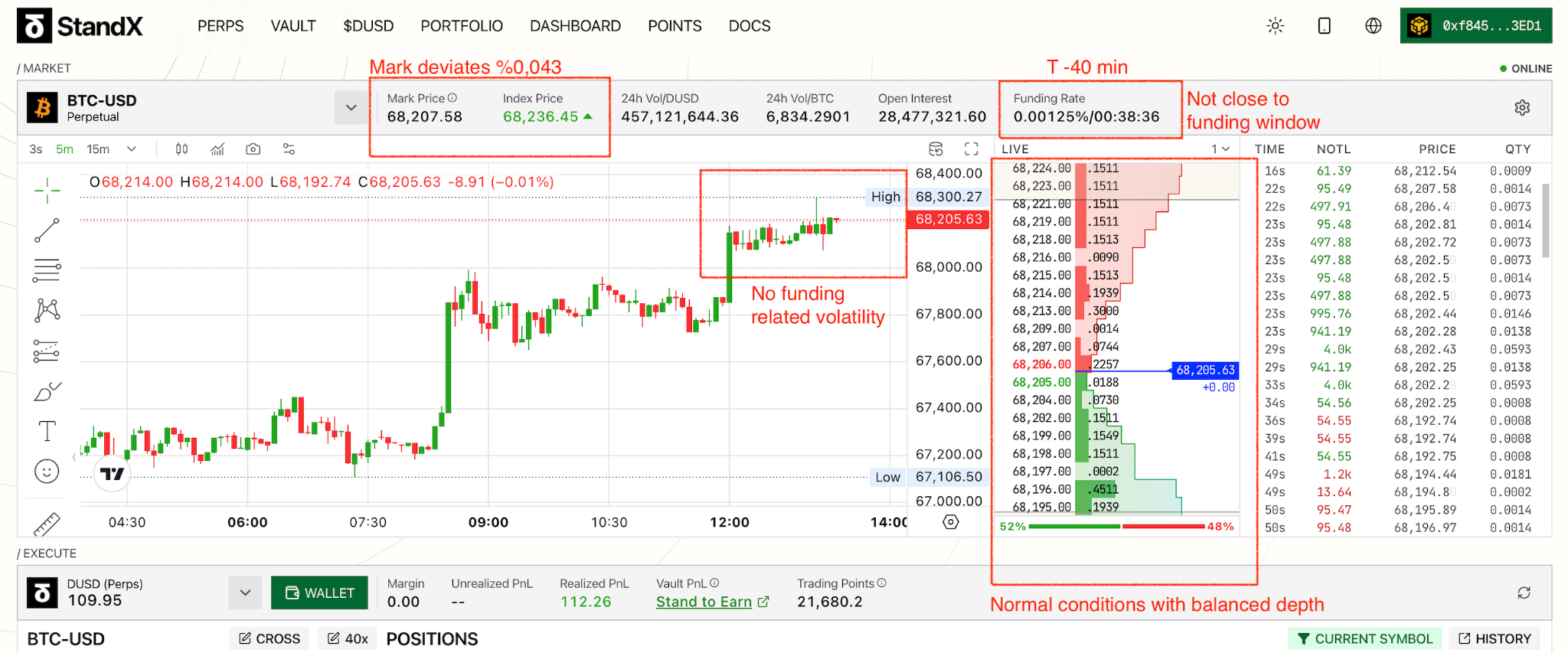
Normal conditions with balanced depth near top levels.
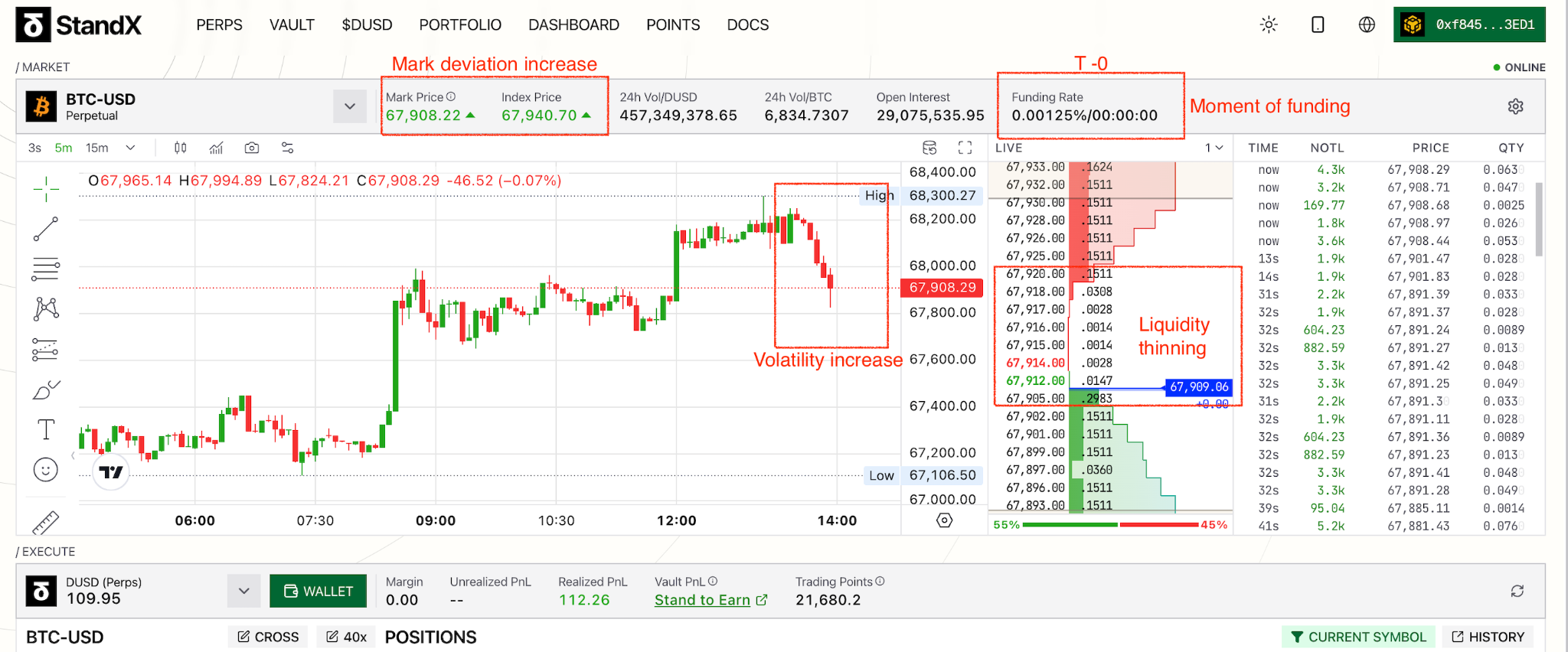
Top of book depth contraction observed prior to funding settlement.
2. Observation - The Liquidity Withdrawal Effect
In practice, this often manifests as:
Reduced passive size at top levels.
Increased spread sensitivity.
Higher impact per unit of aggressive volume.
Funding does not cause volatility directly.
It increases inventory tension.
When inventory tension rises, liquidity becomes more selective.
That selectivity creates a temporary liquidity vacuum.
This is not random, but structural.
3. Execution Distortion - The Hidden Cost of Being Right
Here is where most traders miscalculate.
Even if your directional bias is correct, execution quality degrades near funding clustering.
Why?
Because impact price changes faster when depth is thinner.
StandX funding uses impact bid and impact ask prices in its calculation. Under normal depth conditions, a 50k notional market order may move price by 1-2 bps. Under reduced depth conditions near funding clustering, the same order can produce 6-8 bps impact. The directional view may remain correct. The execution efficiency does not. That means the platform is explicitly sensitive to notional execution size. When liquidity thins, your market order affects price more than expected.
This creates:
Worse average fill.
Increased slippage.
Stop loss overshoot.
Less efficient take profit execution.
Correct direction does not guarantee optimal execution.
That distinction separates experienced traders from reactive ones.
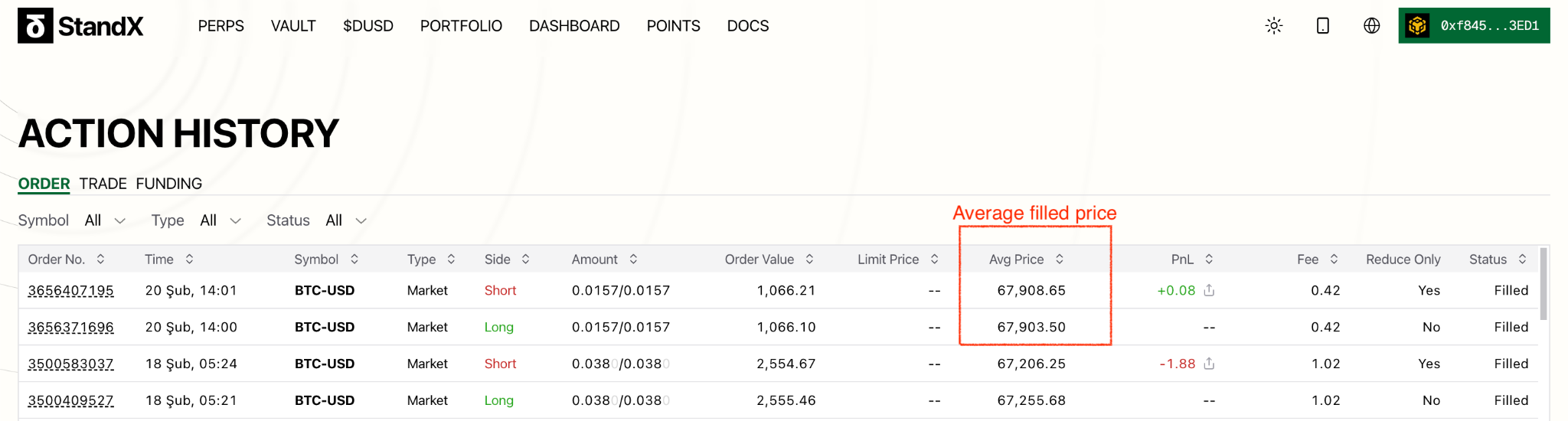
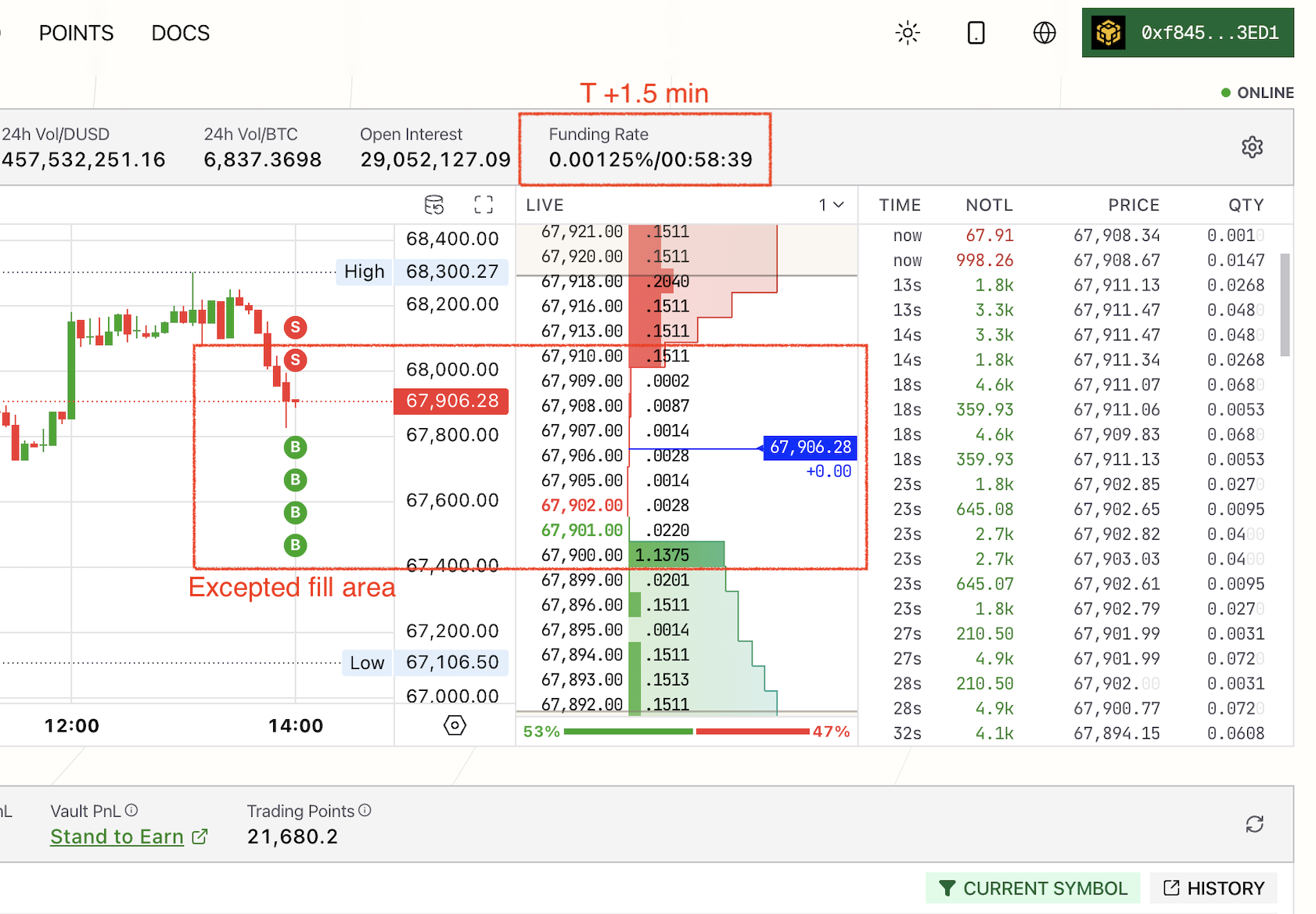
Impact amplification during reduced depth conditions may cause slightly or highly worse fill.
4. Funding and Volatility - Convex Risk
Funding windows alone are manageable.
Funding windows combined with volatility are not.
When volatility expands and orderbook depth contracts simultaneously:
Mark price sensitivity increases relative to index deviation.
When partial liquidations fail to absorb imbalance, auto deleveraging (ADL) probability structurally increases.
ADL is not triggered because the price moved. It is triggered because imbalance could not be resolved through normal liquidation flow. When depth is thin and mark sensitivity increases, that imbalance resolves faster and less gracefully.
The StandX liquidation mechanism relies on mark price, not last traded price. Mark price is derived from price index and premium index behavior.
Mark price incorporates premium behavior.
Premium behavior incorporates impact pricing.
Impact pricing incorporates orderbook depth.
The chain is continuous.
If the premium index widens during thin liquidity conditions, mark price reacts more sensitively.
This can trigger liquidation chains even without extreme last price movement.
Premium widening + thin depth : faster maintenance margin breach, liquidations cascade faster.
Liquidation chains occur even without extreme last price displacement.
Observed stabilization after funding window:
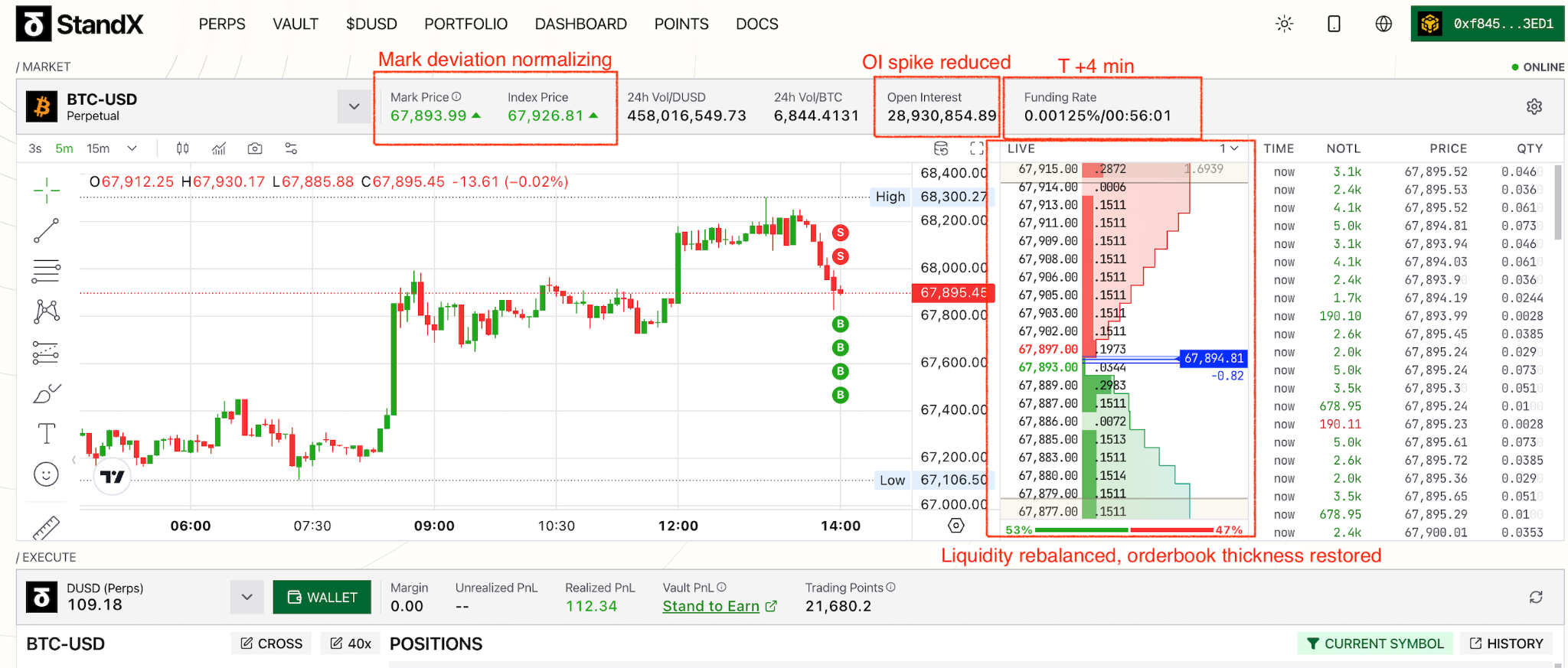
Depth restored and spread normalized.
Deviation between mark price and index price from oracle feed turns minimal.
5. Funding Window Timeline Behavior
T -15 to T -5
Do not increase position size when depth visibly contracts before funding.
T -5 to T -0
Separate directional bias from execution timing. Observe premium expansion as a proxy for imbalance.
T +0 to T +5
Let liquidity normalize before assuming stability.
6. The Subtle Detail Most Traders Notice Too Late
Funding is not the danger.
Liquidity reshaping is.
Most traders only realize this after:
A stop loss that slipped further than expected.
A liquidation that felt too fast.
A perfect entry that filled worse than modeled.
These are not random platform quirks.
They are microstructure responses to inventory imbalance and funding alignment.
StandX’s funding design makes this observable, if you are looking for it.
Structural Awareness
Trading perpetuals is not only about price direction.
It is about:
Liquidity regime.
Inventory pressure.
Funding alignment.
Execution timing.
Funding transfers capital.
Liquidity reshaping transfers edge.
Understanding the difference allows a trader to move from reactive participation to compounding structural awareness.
Structural awareness compounds.
This edge is not visible on the chart.
It is visible in the book.