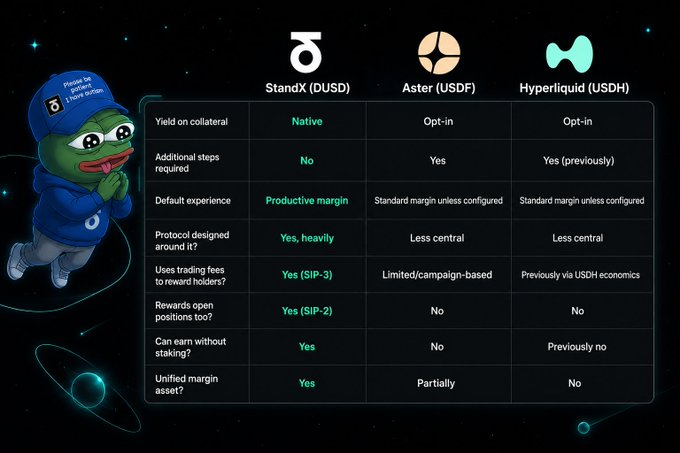
So this is what i see here:
StandX is the only platform of the three where yield on collateral is native. $DUSD continues earning automatically while being used as margin.
StandX doesn’t require any additional steps. There is no staking or configuration needed. By comparison, Aster users need to do more to unlock the strongest version of the $USDF experience, while Hyperliquid’s USDH also required users to opt in.
Third, StandX is the only platform in this comparison that rewards both stablecoin holders and open positions. DUSD holders earn through SIP-3, while traders with open positions can earn through SIP-2.
The StandX team have really baked in the yield on margin benefits in a unique way.
Let’s run it.
bob and Fiona marvel at StandX’s superior model for max capital efficiency
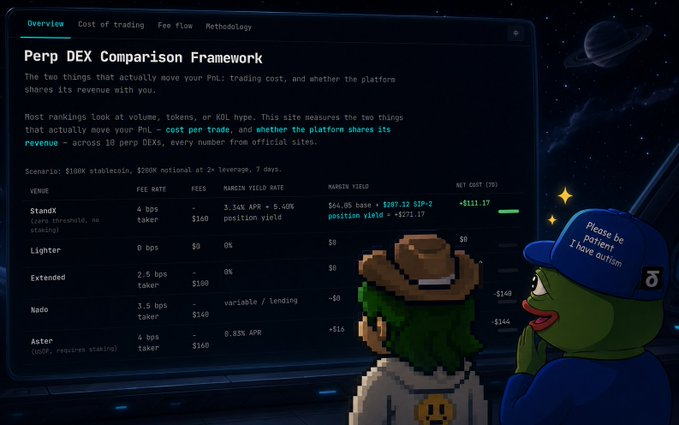
Recently, @CryptoFi_18 built a comparison tool to measure trading fees and whether a platform shares revenue with its users, to see what trading actually costs.
She used the same scenario across venues:
- $100,000 in stablecoins
- $200,000 notional position
- 2x leverage
- Held for seven days
StandX was the only venue in the comparison where the account finished the week ahead. $DUSD margin yield and SIP-2 position yield more than offset the trading fees.
Three approaches to productive collateral

What should happen to the collateral that traders have on a perp dex?
Three perp ecosystems have 3 different answers.
Aster_DEX ‘s $USDF can offer attractive yields, particularly for degens with time to participate in additional programs.
HyperliquidX’s $USDH was an interesting experiment in native stablecoin yield, although the recent transition toward USDC means that story is now changing.
StandX_Official’s $DUSD was built into the foundation of the exchange itself. Deposit $DUSD, use it as margin, and the yield continues automatically. No staking, wrapping or additional steps are required.
might seem small but it changes a lot.