A $10,000 Yield Test at StandX: Zero Friction, ~8% APY, and Free Trading Points (Full Tutorial + Screenshots)
The day the Dow crossed 50,000, Nvidia hit a record $5.7 trillion market cap, and the Nasdaq set another all-time high, Wall Street looked like it had rediscovered the money printer. Meanwhile, BTC got rejected at $82,000 for the fourth time and slipped below $80,000.
TradFi is partying. Crypto is grinding.
Over the past few years, crypto users have been conditioned by two kinds of yield:
- The flashy 30% APY that turns out to be governance token emissions — only for the token to dump 90% before your rewards even vest.
- Or the “safe” 3% stablecoin yield that feels like lukewarm water from a bank teller.
In 2026, mainstream stablecoin yields have been crushed into a narrow 3–4% band: Coinbase 3.35%, Aave 3.31%, Ethena 3.60%. Everyone is queuing under the same low ceiling.
So when I first saw DUSD showing ~8% APY — paid entirely in real stablecoin — my reaction was probably the same as yours:
Is this number even real?
I decided to find out the most honest way possible: put in my own money.
$10,000. Two accounts. A perfectly hedged BTC long/short position via Block Trade — a first-of-its-kind cross-chain execution layer that settles P2P trades on-chain without touching the orderbook. No directional bets, no hype chasing — just testing whether DUSD can genuinely generate sustainable yield on its own.
8 days later, I got my answer.
The Result: $10,000, 8 Days, $17 Earned With Zero Directional Risk
Last week I set up two accounts on StandX, deposited 5,000 USDT each, and used StandX’s Unique Block Trade feature to hedge them against each other (one long, one short). Net directional risk: zero — BTC price movement is irrelevant to me.
Today:
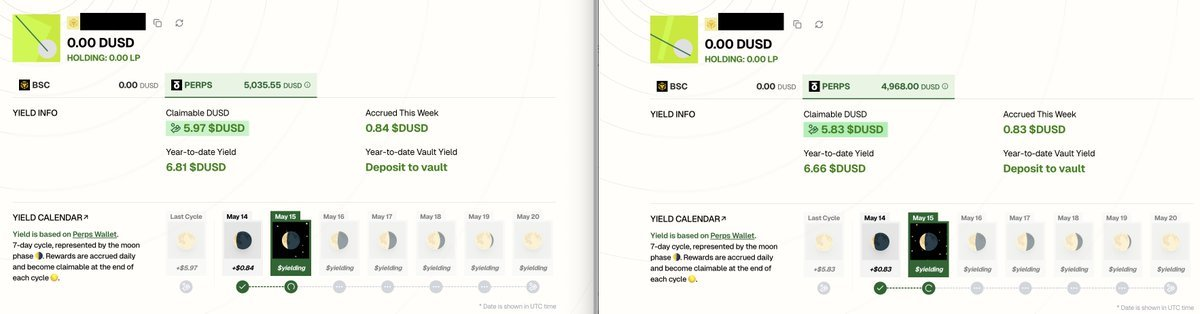
Combined across both accounts:
- 💰 DUSD Yield (Base + SIP-3): $13.47 ($6.81 + $6.66)
- 💰 Position Yield (SIP-2): $3.44 ($1.72 × 2)
- 📊 Total earnings: $16.91 — annualized ~7.8%
- 🎯 Trading Points: 380+
- ⚡ Directional risk: zero
- 🔥 Friction: zero
Don’t worry about the jargon — I’ll break down exactly where each layer of yield comes from below :)
Perps Trading Page
APY Stack reads 8.46% in real time, and earnings are compounding daily.
Note: $16.91 annualizes to ~7.8% — that’s the 8-day average (May 7–15). The displayed 8.46% is today’s real-time rate, which is higher because trading volume (and therefore fee revenue) picked up in recent days.
Yield Breakdown — Where Does 8.46% APY Come From?
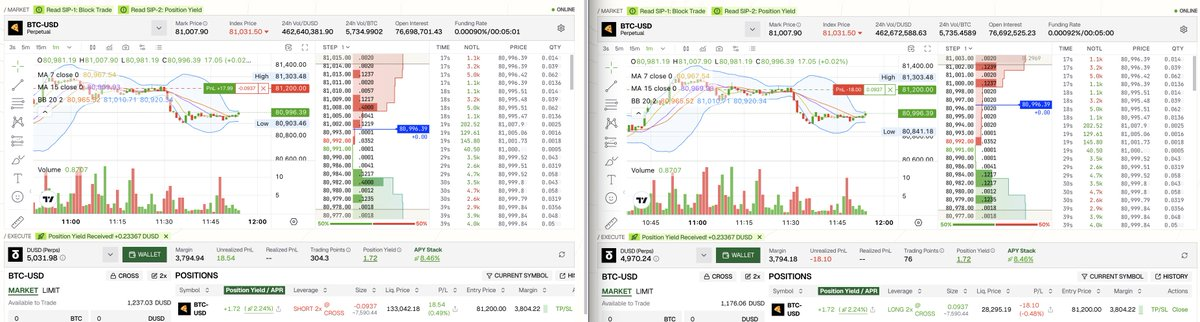
Layer 1: DUSD Base — 1.27%
Baseline yield for all DUSD holders, derived from funding rate capture (same model as Ethena’s USDe).
Layer 2: SIP-2 Position Yield Boost — 2.27%
A mechanism unique to StandX — and no, it’s not a subsidy. SIP-2 runs on a self-reinforcing flywheel:
You open a position → liquidity deepens → volume grows → fees increase → your yield rises → more users join → 🔁
Why does this flywheel work? When you open a position — long or short — you’re providing the liquidity that POWERS the platform. SIP-2 is Protocol Revenue Sharing — real trading fees routed back to the users who provide liquidity. Same logic as Hyperliquid’s fee model.
Leverage = yield amplifier. 2x leverage = 2x boost. You put up 1,000 DUSD for a 2x position, taking on 2,000 DUSD of risk exposure. Yield is calculated on your risk exposure, not your capital. More risk, more return. Logically fair.
Layer 3: SIP-3 Universal Fee Distribution — 4.92%
The largest yield component — and the broadest. A portion of trading fees on StandX goes to every DUSD holder, regardless of whether you trade, hold positions, or even log in. Hold DUSD, earn yield. That’s it.
The critical point: all three layers pay out in DUSD (USD stablecoin). Every dollar you earn is real.
8% in a 3% world — and structurally sustainable
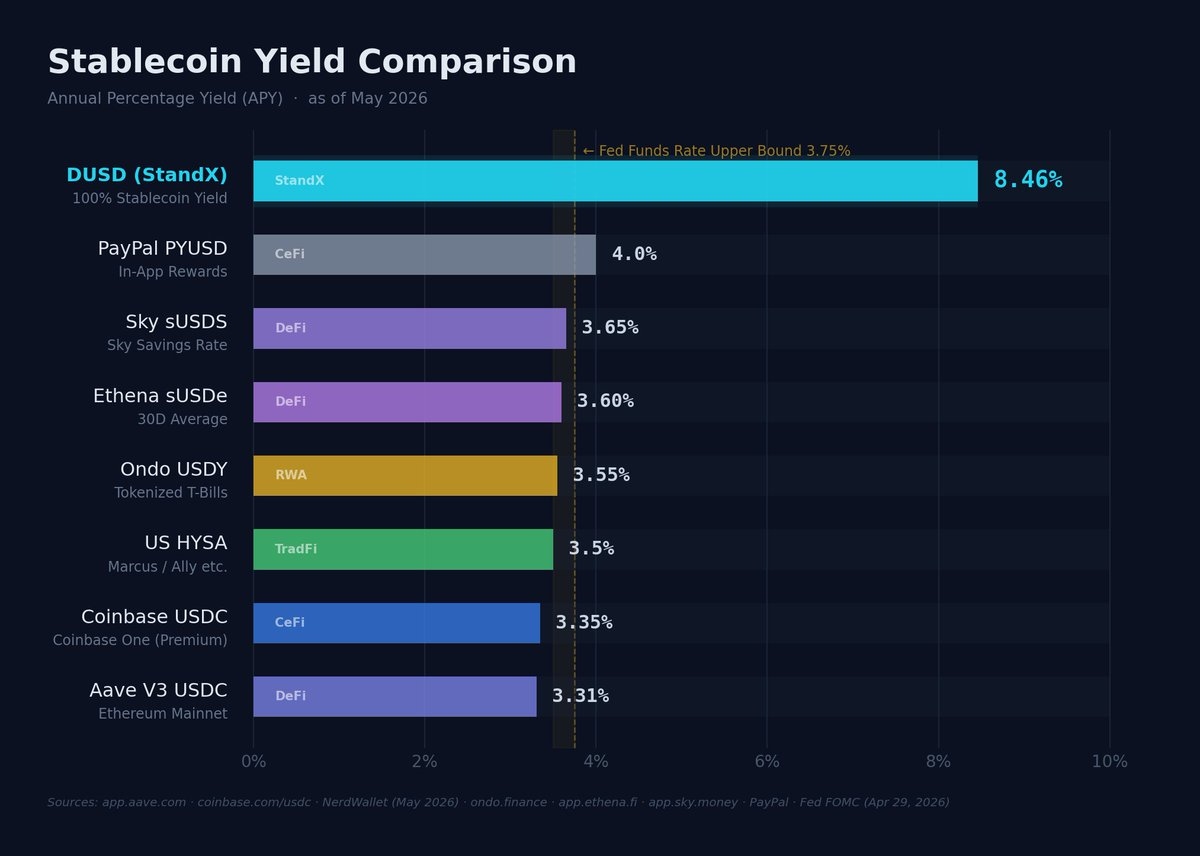
With the Fed at 3.50–3.75%, stablecoin yields have converged into a tight 3–4% band — Aave 3.31%, Ethena 3.60%, Coinbase 3.35%, etc. DUSD sits at 8.46%: more than 2x the field.
Built to last. Most yield stablecoins live and die by funding rates — strong in bull runs, crushed in downturns. DUSD is structurally different: over 7% of the 8.46% comes from trading fees (SIP-2 + SIP-3), which flow regardless of market direction.
This is by design — built for the long term. SIP-3 added an exchange-driven revenue layer on top of DUSD’s existing funding rate yield — turning it into a base-layer asset that directly captures the economic value of the platform it powers. The yield grows with the platform, not with market sentiment. That’s what makes it sustainable.
3 Steps to Copy This Strategy — Zero Friction
The whole process takes under five minutes. You need: two wallets, 5,000 USDT each, small amount of BNB for gas.
- Step 1: Get DUSD and Deposit to Perps Wallet
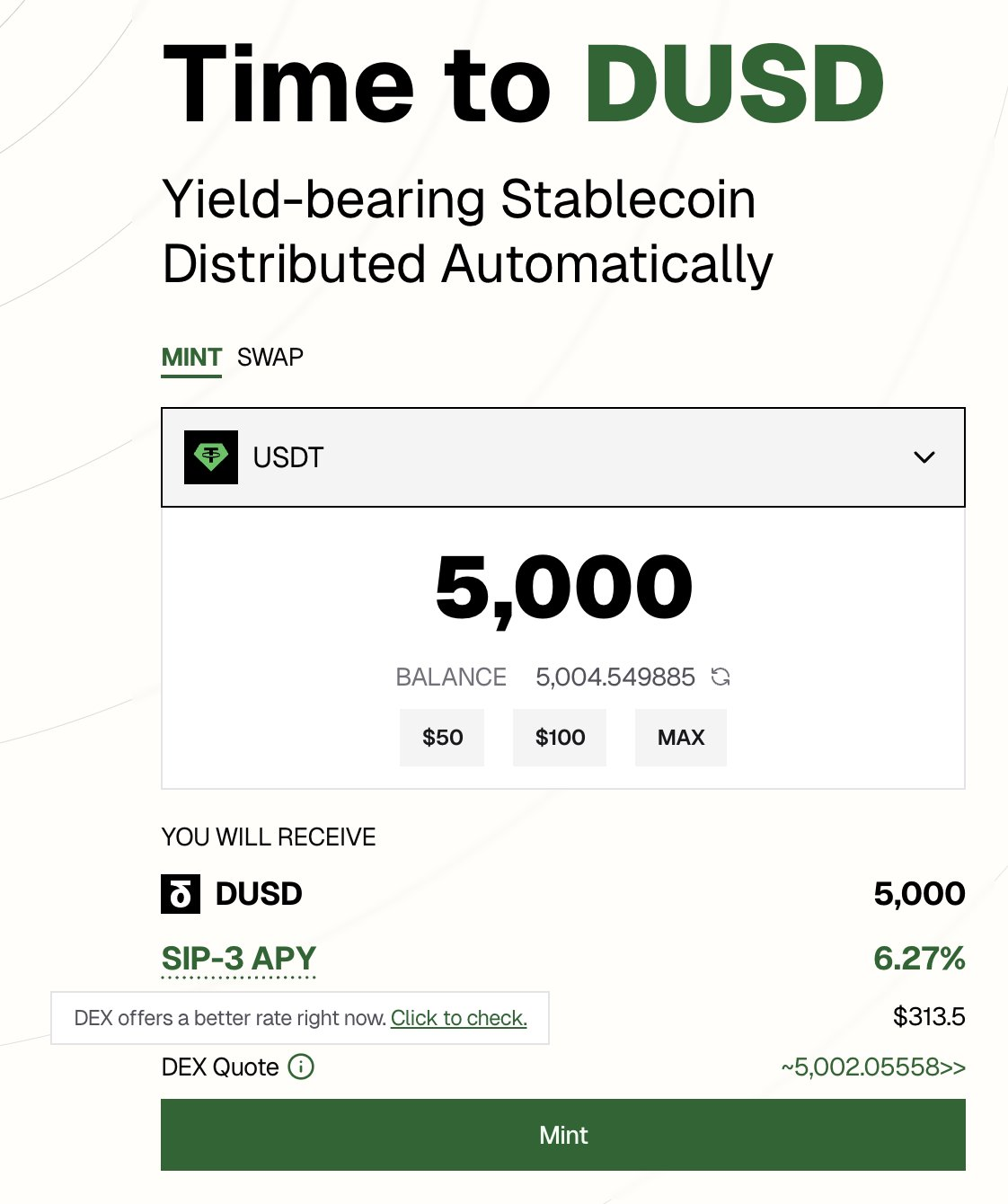
Log into standx.com with both wallets →$DUSD page → choose Swap (slightly better rate than Mint) → 5,000 USDT → ~5,002 DUSD. Note: our system will helpfully show you when the DEX offers a better rate :)
Then go to Perps trading page → click WALLET → DEPOSIT → deposit your DUSD balance.
- Step 2: Account A Creates Block Trade (Long Position)
PERPS → Block Trade → + Open Block → BTC-USD, CROSS · 2X, Limit price, FullMatch → click LONG → PUBLISH ONCHAIN.
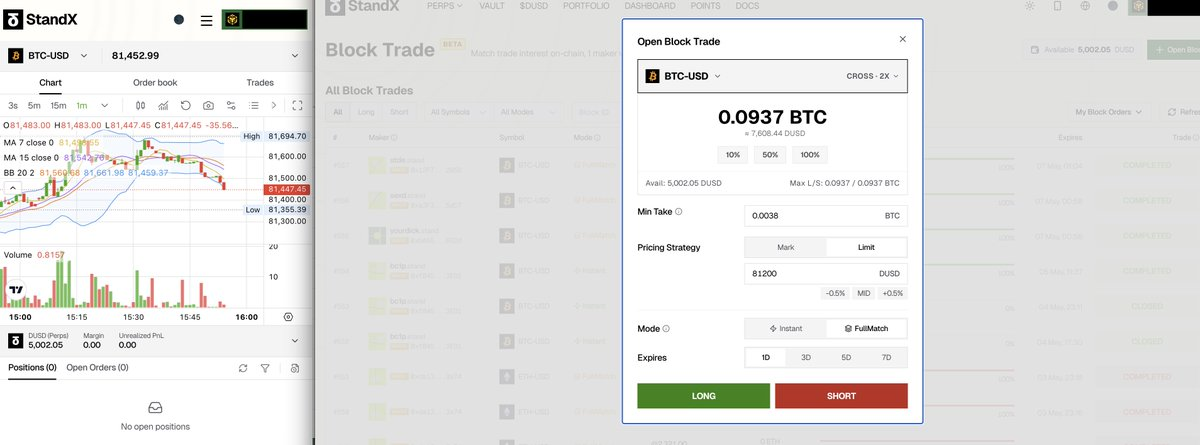
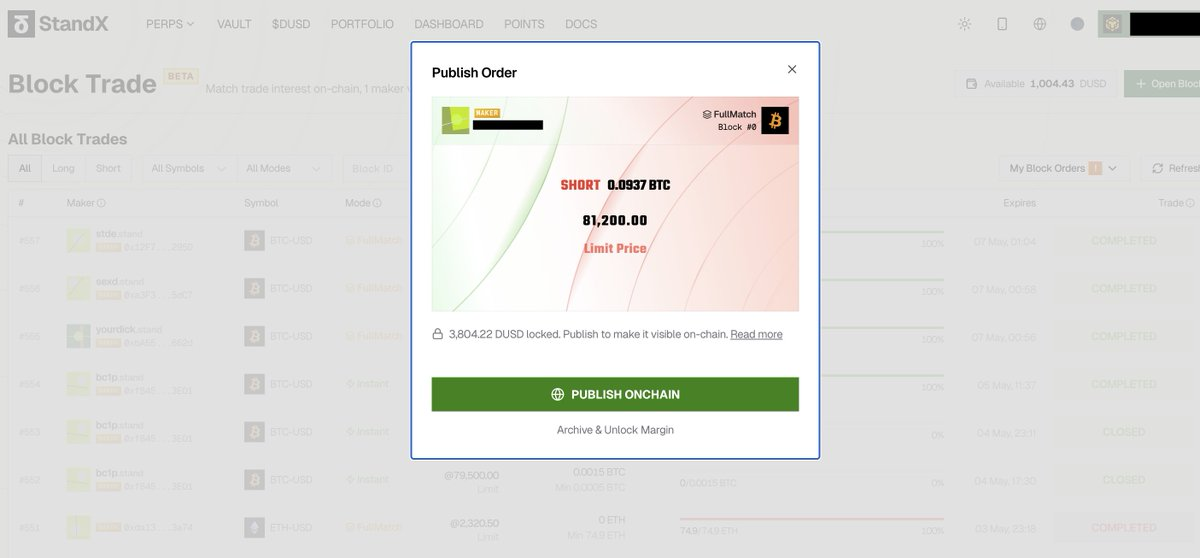
Copy the share link to your other wallet.
- Step 3: Account B Joins Block Trade (Short Position)
Switch to Wallet B → find the Block Trade → change leverage to CROSS · 2X (default may be 10X) → JOIN SHORT → Confirm → Publish Onchain.
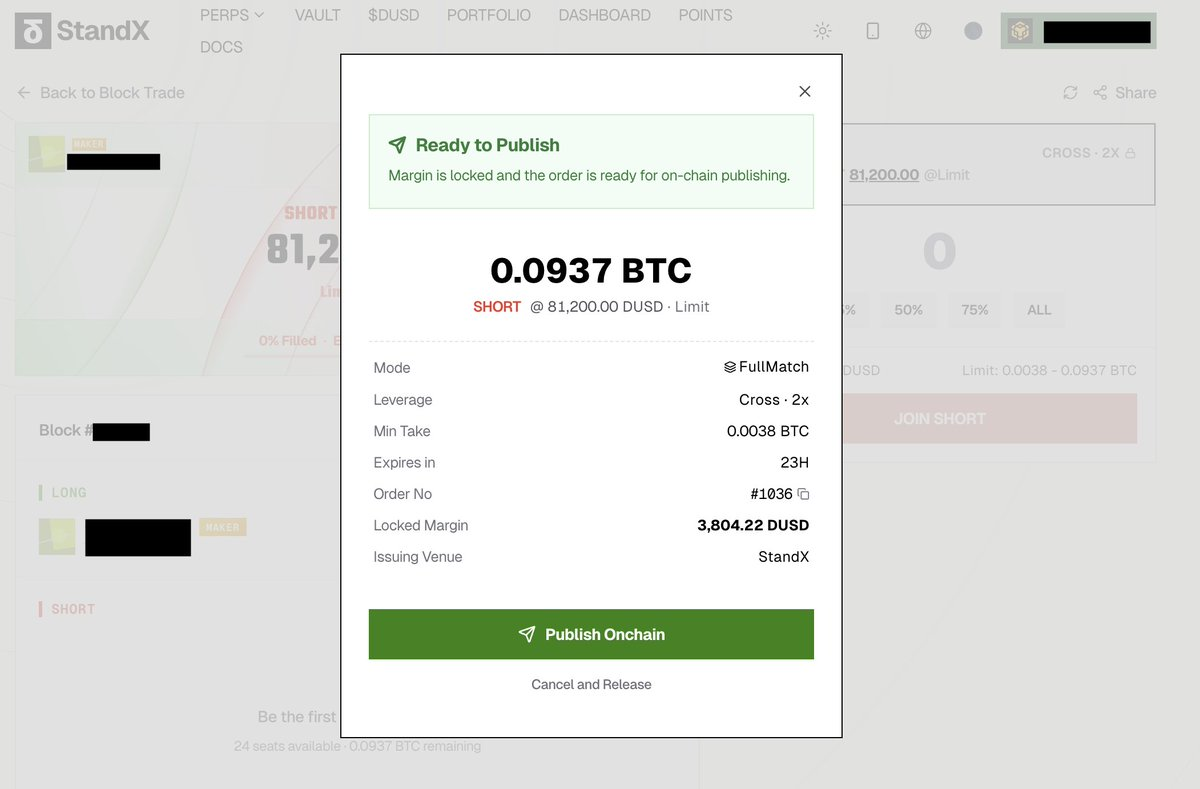
Done — perfectly hedged:
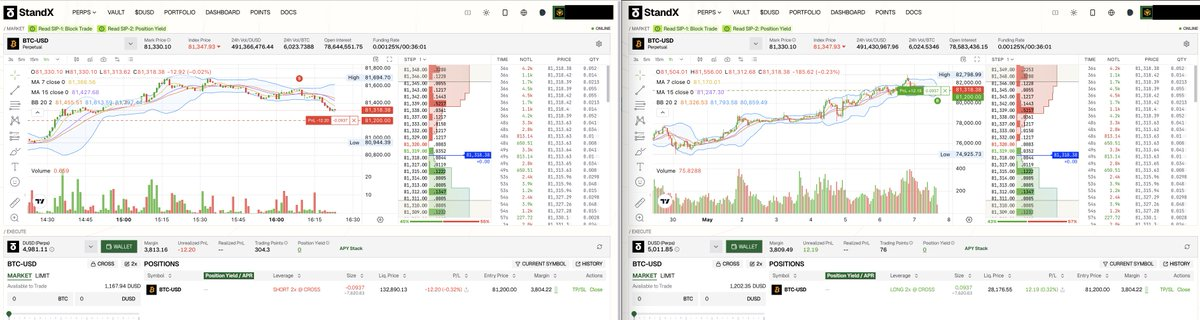
Left: -$12.20 | Right: +$12.19. Net PnL ≈ $0.
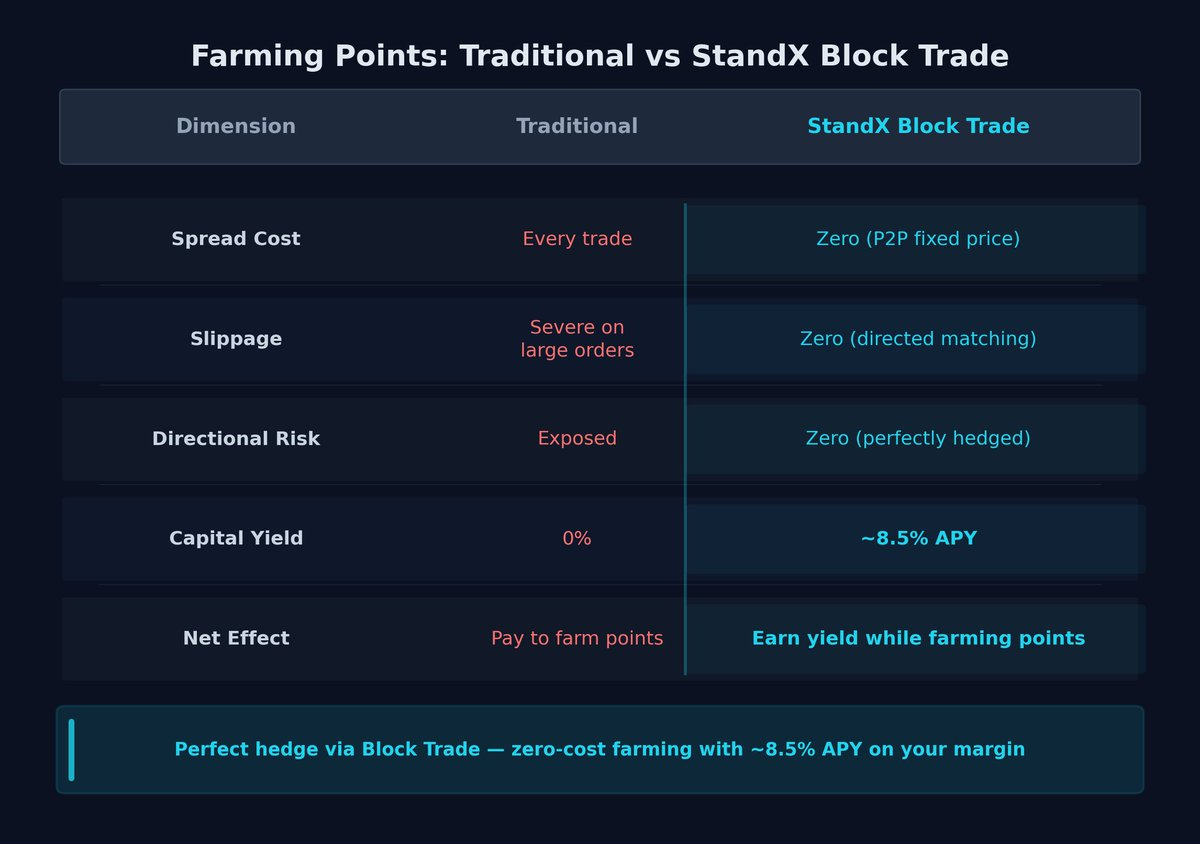
Why This Strategy Costs You Nothing
Point farming on most Perps DEXs costs real money. If you try to hedge your positions, entry prices are nearly impossible to match precisely, slippage eats into both sides, and funding rates settle on different schedules — your “hedge” leaks value with every round trip.
Block Trade eliminates all of this:
Risks
① Smart contract risk. The baseline risk of all DeFi protocols. StandX contracts are audited, but no protocol is guaranteed bulletproof.
② Yield variability. 8.46% is not fixed. The Base layer fluctuates with funding rates; SIP-2/3 depend on trading volume. But a fee-driven structure has structurally better cycle resilience than pure funding rate models.
What’s Next
Next up, I want to share a different lens on StandX. After 5+ years evaluating protocols from the VC side, I keep noticing things about this project that the market hasn’t fully priced in — like why some higher-ranked DEXs on DefiLlama show BTC perp spreads $20–30 wider than StandX vs CEX (headline volume and what users actually experience when they trade are two different things), or how the design thinking behind SIP-1 through SIP-3 reflects an institutional-grade approach to derivative infrastructure that most DeFi teams simply don’t have. Great product, low awareness — probably the most common and most painful gap in crypto. The next article tries to address that.